
- Complete Technical Guide
How to Choose the Right UTM for Your Application
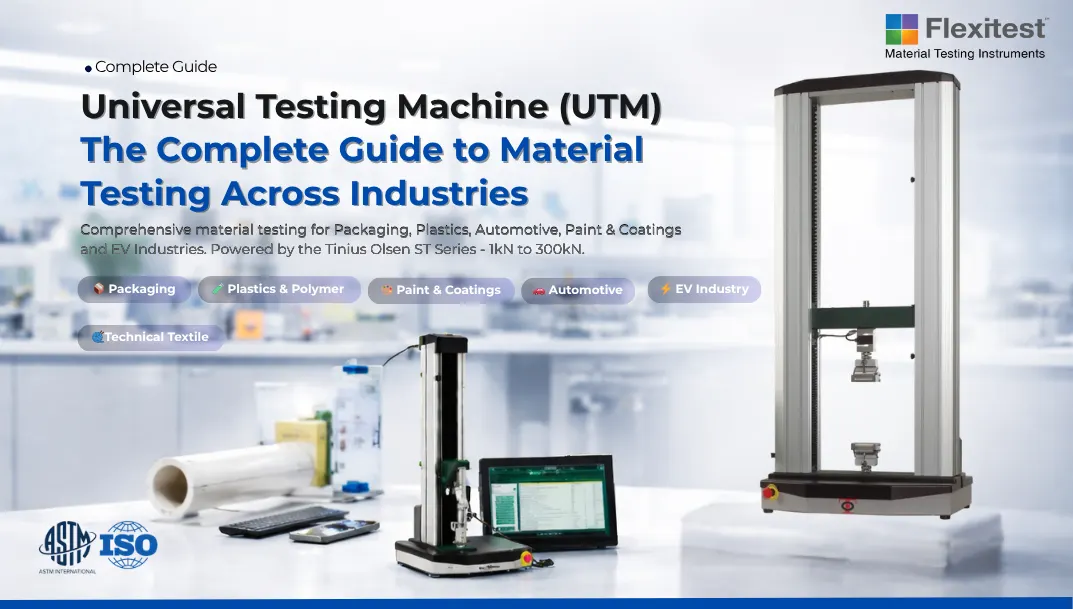
Material testing for Packaging, Plastic & Polymer , Automotive, Paint & Coating, and EV Industries – powered by the Tinius Olsen ST Series
1kN - 300kN
Force Range
5
Industry Sectors
35+
ASTM / ISO Standards
2,730/s
Data Sample Rate
Why Choose the Tinius Olsen ST Series?
With over 140 years of materials testing expertise, Tinius Olsen’s ST Series represents the pinnacle of electromechanical universal testing technology. Here’s what sets it apart:
Complete Range: 1kN to 300kN
Every industry works with materials that must perform under stress – and a Universal Testing Machine (UTM Machine) is the one instrument that validates whether they actually will. In packaging, it checks if a sealed pouch will survive transit without tearing or a laminated film will hold its bond. In plastics and polymers, it confirms that an injection-moulded part or extruded pipe has consistent strength from batch to batch. In automotive, it verifies that chassis steel, seatbelt webbing, and dashboard plastics can handle the forces they’ll face on the road. In paint and coatings, it measures whether a coating will peel off, crack under bending, or lose adhesion over time. In the EV sector, it tests battery separator films, electrode coatings, and lightweight body panels to ensure passenger safety. In technical textiles, it validates that high-performance fabrics used in aerospace, defence, and medical applications can withstand extreme tensile and tear forces. Across all these sectors, the UTM delivers one thing every manufacturer needs – precise, repeatable, standards-compliant data that proves a material is safe and fit for purpose before it reaches the end user.
How Does a Universal Testing Machine Work?
A UTM works by applying a controlled force to a test specimen and measuring the material’s response. The core components include:
Complete Range: 1kN to 300kN
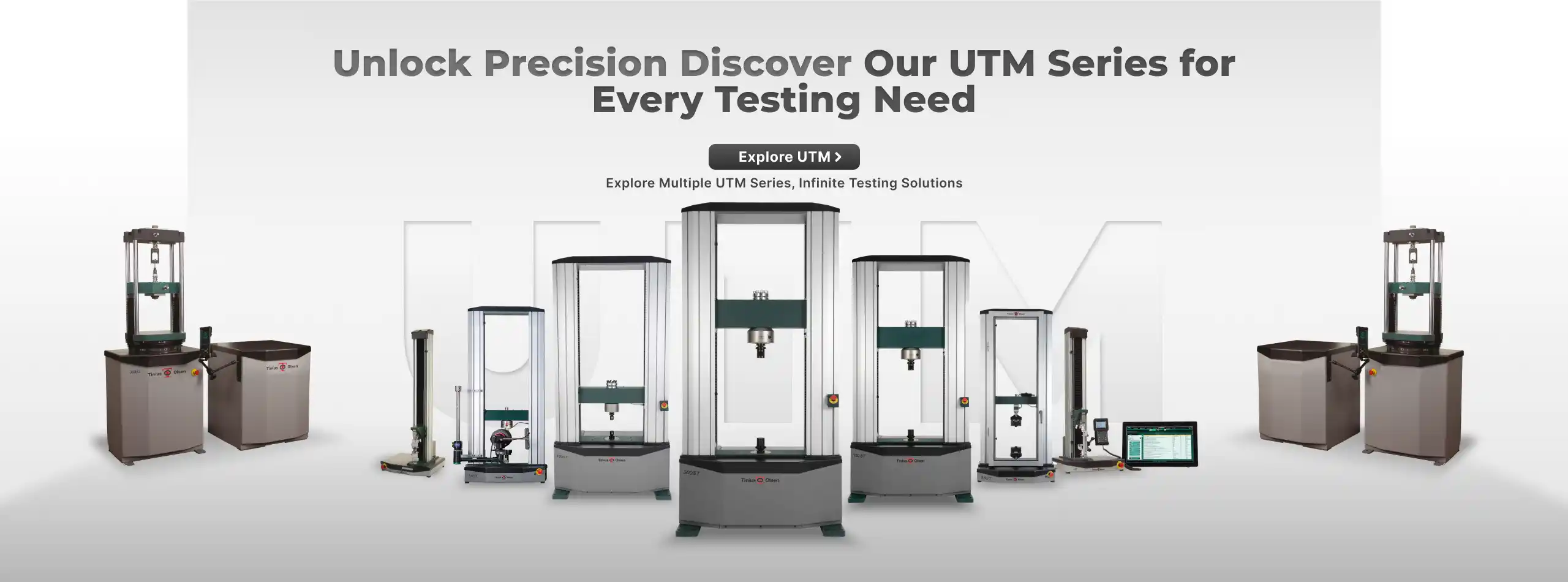
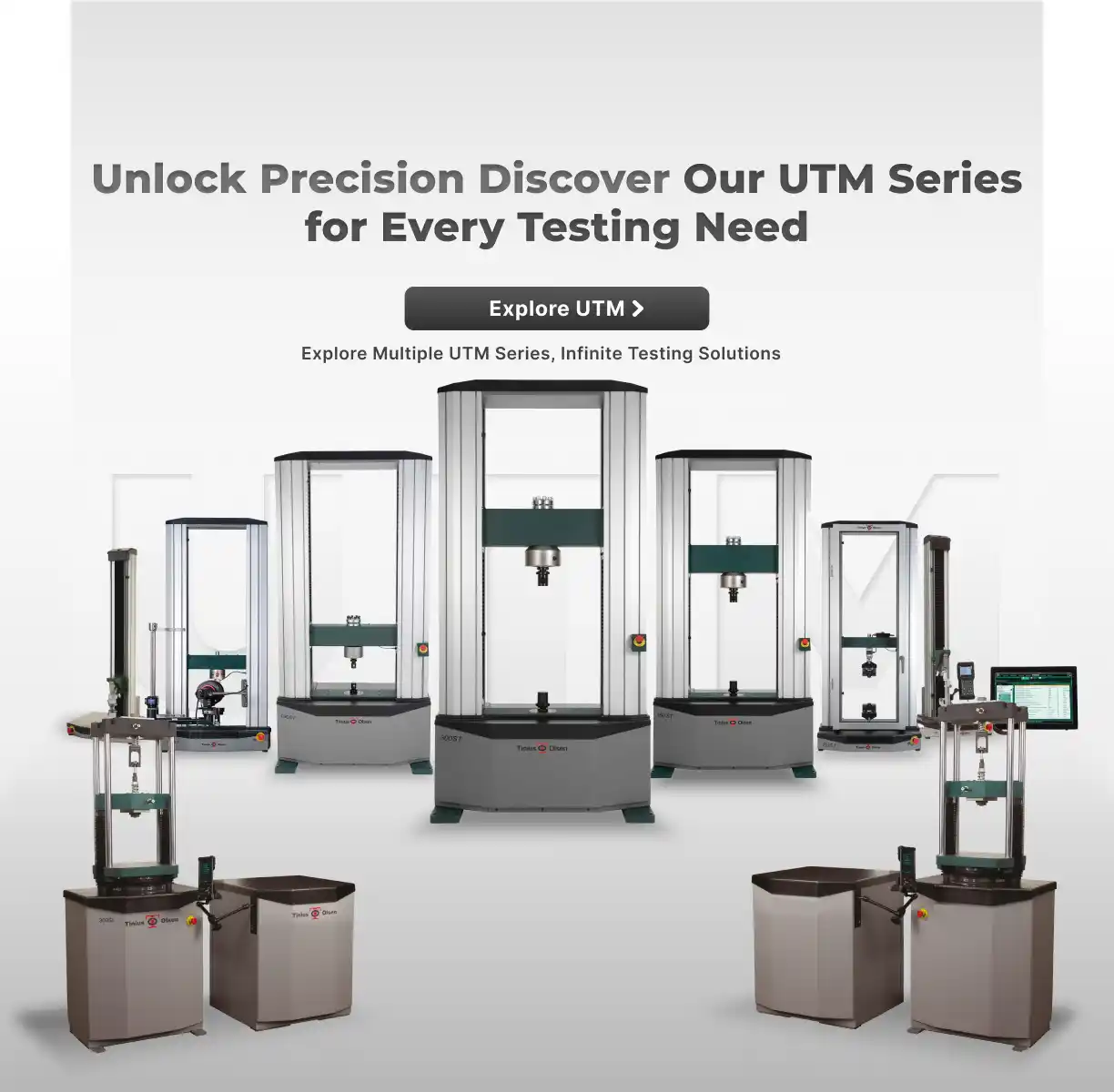
The ST Series spans eight models — from the compact 1ST benchtop unit for film and packaging testing to the powerful 300ST floor-standing system for metals, composites, and heavy-duty industrial testing. Whatever your capacity requirement, there is an ST model for you.
Unmatched Accuracy
The ST Series achieves load measurement accuracy of better than 0.2% of the reading from 0.2–100% of the load cell capacity, meeting or exceeding ASTM E4, ISO 7500-1, and EN 10002-2 requirements.
High-Speed Data Acquisition
With an internal sample rate of up to 2,730 samples per second per channel, the ST Series captures even the fastest material events. The 1kHz USB2 data transfer to Horizon software ensures clean, noise-free data for reliable results.
Horizon Materials Testing Software
Horizon software provides a comprehensive library of standardised test routines, powerful report writing, graphical data analysis, simultaneous multi-machine control, and multilayered security. It is networkable and scalable, allowing operators and managers to operate equipment and review results from multiple locations.
Flexible Accessories & Connectivity
Self-identifying load cells, built-in pneumatic supply for grips, T-slot columns for uncluttered test areas, up to four accessory connections, and a full complement of extensometers (optical, video, automatic, encoder, laser, strain gauge, and LVDT) make the ST Series the most versatile UTM platform available.
Multiple Interface Options
Choose from a Virtual Machine Controller (VMC) on a connected PC, a Bluetooth wireless handheld interface (HMC3.0) with 13MP camera and WiFi, or a tethered Proterm interface with large tactile buttons for gloved operation.
Unmatched Accuracy
The ST Series achieves load measurement accuracy of better than 0.2% of the reading from 0.2–100% of the load cell capacity, meeting or exceeding ASTM E4, ISO 7500-1, and EN 10002-2 requirements.
High-Speed Data Acquisition
With an internal sample rate of up to 2,730 samples per second per channel, the ST Series captures even the fastest material events. The 1kHz USB2 data transfer to Horizon software ensures clean, noise-free data for reliable results.
Horizon Materials Testing Software
Horizon software provides a comprehensive library of standardised test routines, powerful report writing, graphical data analysis, simultaneous multi-machine control, and multilayered security. It is networkable and scalable, allowing operators and managers to operate equipment and review results from multiple locations.
Flexible Accessories & Connectivity
Self-identifying load cells, built-in pneumatic supply for grips, T-slot columns for uncluttered test areas, up to four accessory connections, and a full complement of extensometers (optical, video, automatic, encoder, laser, strain gauge, and LVDT) make the ST Series the most versatile UTM platform available.
Multiple Interface Options
Choose from a Virtual Machine Controller (VMC) on a connected PC, a Bluetooth wireless handheld interface (HMC3.0) with 13MP camera and WiFi, or a tethered Proterm interface with large tactile buttons for gloved operation.
Complete Range: 1kN to 300kN
The ST Series spans eight models — from the compact 1ST benchtop unit for film and packaging testing to the powerful 300ST floor-standing system for metals, composites, and heavy-duty industrial testing. Whatever your capacity requirement, there is an ST model for you.
Complete Range: 1kN to 300kN
The ST Series spans eight models — from the compact 1ST benchtop unit for film and packaging testing to the powerful 300ST floor-standing system for metals, composites, and heavy-duty industrial testing. Whatever your capacity requirement, there is an ST model for you.
Unmatched Accuracy
The ST Series achieves load measurement accuracy of better than 0.2% of the reading from 0.2–100% of the load cell capacity, meeting or exceeding ASTM E4, ISO 7500-1, and EN 10002-2 requirements.
High-Speed Data Acquisition
With an internal sample rate of up to 2,730 samples per second per channel, the ST Series captures even the fastest material events. The 1kHz USB2 data transfer to Horizon software ensures clean, noise-free data for reliable results
Peel & Adhesion
Measures bond strength between laminates, coatings, labels, and sealed packaging at 90° or 180° angles.
Tear Testing
Evaluates force required to propagate a tear through films, textiles, rubber, and flexible packaging.
Shear Testing
Measures resistance to sliding forces. Important for adhesives, fasteners, and composite interlaminar testing.
COF Testing
Determines static and kinetic friction of films. Critical for packaging runnability and EV separator film handling.
Types of Tests Performed on a UTM
A Universal Testing Machine can perform a wide variety of mechanical tests. The most common ones relevant to industrial quality control include:
Tensile Testing
Measures resistance to being pulled apart. Determines tensile strength, yield strength, elongation, and Young’s modulus.
Compression Testing
Evaluates behaviour under crushing force. Essential for rigid plastics, packaging containers, and EV battery enclosures.
Flexural Testing
Determines resistance to cracking under bending stress using 3-point or 4-point methods.
Peel & Adhesion
Measures bond strength between laminates, coatings, labels, and sealed packaging at 90° or 180° angles.
Tear Testing
Evaluates force required to propagate a tear through films, textiles, rubber, and flexible packaging.
Shear Testing
Measures resistance to sliding forces. Important for adhesives, fasteners, and composite interlaminar testing.
COF Testing
Determines static and kinetic friction of films. Critical for packaging runnability and EV separator film handling.
UTM Machine Applications by Industry
1. UTM for Packaging Industry
The packaging sector relies heavily on UTMs for quality control of flexible and rigid packaging materials. From verifying heat-seal integrity on food pouches to testing the compressive strength of shipping containers, a UTM is indispensable in any packaging QC lab.
Recommended Models: 1ST (1kN), 5ST (5kN), 10ST (10kN), 25ST (25kN)
Key ASTM & ISO Standards for Packaging
| ASTM | ISO | Test Name | Application |
|---|---|---|---|
| ASTM F88 | ISO 11607 | Seal Strength | Heat-sealed pouches, medical packaging, food sachets |
| ASTM D882 | ISO 527-3 | Film Tensile | Tensile strength & elongation of plastic films (<1mm) |
| ASTM D1894 | ISO 8295 | Coefficient of Friction | Static & kinetic COF for packaging line runnability |
| ASTM F904 | ISO 8510-1 | Bond / Peel Strength | Ply adhesion of laminates (film, foil, paper) |
| ASTM D828 | ISO 1924 | Paper Tensile | Tensile properties of paper & paperboard packaging |
| ASTM D903 | ISO 8510-2 | Adhesive Peel | 180° peel strength of labels, tapes, and adhesives |
| ASTM D642 | ISO 12048 | Compression | Compressive resistance of containers, caps, closures |
Submit Your Details to Download Brochure!
2. UTM for Plastics & Polymer Industry
Plastics and polymer testing is the largest application segment for UTMs globally. From injection-moulded components to extruded profiles and thin films, every plastic product requires mechanical property validation before it reaches the market.
Recommended Models: 5ST (5kN), 10ST (10kN), 25ST (25kN)
Key ASTM & ISO Standards for Plastics & Polymers
| ASTM | ISO | Test Name | Application |
|---|---|---|---|
| ASTM D638 | ISO 527-1/2 | Plastic Tensile | Tensile strength of rigid & semi-rigid plastics (dumbbell specimens) |
| ASTM D882 | ISO 527-3 | Film Tensile | Tensile properties of thin plastic films & sheeting |
| ASTM D790 | ISO 178 | Flexural Test | 3-point bending strength of plastics & composites |
| ASTM D695 | ISO 604 | Compression | Compressive strength of rigid plastics |
| ASTM D412 | ISO 37 | Rubber Tensile | Tensile strength of elastomers & rubber compounds |
| ASTM D624 | ISO 34-1 | Tear Strength | Tear resistance of rubber & elastomers |
| ASTM D1894 | ISO 8295 | COF | Coefficient of friction of plastic films |
Submit Your Details to Download Brochure!
3. UTM for Automotive Industry
The automotive sector demands rigorous material testing machine across metals, plastics, composites, rubber, adhesives, and coatings. From dashboard plastics to structural steel, seatbelts to under-the-hood rubber hoses, UTMs validate every component that goes into a vehicle.
Recommended Models: 25ST (25kN), 50ST (50kN), 100ST (100kN), 150ST (150kN), 300ST (300kN)
Key ASTM & ISO Standards for Automotive
| ASTM | ISO | Test Name | Application |
|---|---|---|---|
| ASTM E8 | ISO 6892-1 | Metal Tensile | Tensile strength of steel, aluminium, and alloy components |
| ASTM D638 | ISO 527-1/2 | Plastic Tensile | Dashboard, bumper, and interior plastic components |
| ASTM D790 | ISO 178 | Flexural Test | Bending strength of structural polymer parts |
| ASTM A370 | — | Steel Mechanical | Mechanical properties of steel (tension, bend, hardness) |
| ASTM D412 | ISO 37 | Rubber Tensile | Rubber seals, gaskets, hoses, and weather strips |
| ASTM D3039 | ISO 527-4 | Composite Tensile | Carbon/glass fibre-reinforced structural composites |
| ASTM D6775 | — | Webbing Tensile | Seatbelts, harnesses, safety restraint systems |
Submit Your Details to Download Brochure!
4. UTM for Paint & Coating Industry
Coating and paint manufacturers use UTMs to evaluate adhesion strength, flexibility, tensile properties of free films, and peel resistance of coated substrates. These tests are critical for automotive paints, industrial coatings, powder coatings, and protective films.
Recommended Models: 10ST (10kN), 50ST (50kN), 100ST (100kN) , 300ST (300kN)
Key ASTM & ISO Standards for Paint & Coatings
| ASTM | ISO | Test Name | Application |
|---|---|---|---|
| ASTM D4541 | ISO 4624 | Pull-Off Adhesion | Adhesion strength of coatings using portable pull-off testers |
| ASTM D903 | ISO 8510-2 | Peel Strength | 180° peel adhesion of coatings, films, and laminates |
| ASTM D882 | ISO 527-3 | Free Film Tensile | Tensile properties of coating free films & paint films |
| ASTM D2370 | — | Elongation of Coatings | Tensile elongation of applied organic coatings |
| ASTM D3359 | — | Tape Adhesion Test | Cross-hatch adhesion test for coatings on substrates |
| ASTM D522 | ISO 1519 | Mandrel Bend | Flexibility & crack resistance of coatings on metal panels |
| ASTM D2794 | ISO 6272 | Impact Resistance | Rapid deformation (impact) resistance of organic coatings |
Submit Your Details to Download Brochure!
The rapidly growing EV sector introduces unique material testing challenges. From battery cell components to lightweight structural materials, every element must be tested for safety, durability, and regulatory compliance. UTMs play a critical role in EV battery manufacturing, lightweight material development, and component validation.
Recommended Models: 10ST (10kN)
Key ASTM & ISO Standards for EV Industry
| ASTM | ISO | Test Name | Application |
|---|---|---|---|
| ASTM D882 | ISO 527-3 | Separator Film Tensile | Tensile strength of battery separator films |
| ASTM D1894 | ISO 8295 | Separator COF | Friction of separator films for winding quality control |
| ASTM D903 | ISO 8510-2 | Electrode Peel | Peel adhesion of electrode coatings on current collectors |
| ASTM E8 | ISO 6892-1 | Metal Tensile | Aluminium/copper foil and busbar tensile properties |
| ASTM D638 | ISO 527-1/2 | Plastic Tensile | Battery enclosure and housing polymer components |
| ASTM D3039 | ISO 527-4 | Composite Tensile | Lightweight CFRP/GFRP structural body panels |
| ASTM D695 | ISO 604 | Cell Compression | Compressive strength of battery cell enclosures & spacers |
Submit Your Details to Download Brochure!
Every industry works with materials that must perform under stress – and a Universal Testing Machine (UTM Machine) is the one instrument that validates whether they actually will. In packaging, it checks if a sealed pouch will survive transit without tearing or a laminated film will hold its bond. In plastics and polymers, it confirms that an injection-moulded part or extruded pipe has consistent strength from batch to batch. In automotive, it verifies that chassis steel, seatbelt webbing, and dashboard plastics can handle the forces they’ll face on the road. In paint and coatings, it measures whether a coating will peel off, crack under bending, or lose adhesion over time. In the EV sector, it tests battery separator films, electrode coatings, and lightweight body panels to ensure passenger safety. In technical textiles, it validates that high-performance fabrics used in aerospace, defence, and medical applications can withstand extreme tensile and tear forces. Across all these sectors, the UTM delivers one thing every manufacturer needs – precise, repeatable, standards-compliant data that proves a material is safe and fit for purpose before it reaches the end user.
| ASTM | ISO | Test Name | Application |
|---|---|---|---|
| ASTM D882 | ISO 527-3 | Separator Film Tensile | Tensile strength of battery separator films |
| ASTM D1894 | ISO 8295 | Separator COF | Friction of separator films for winding quality control |
| ASTM D903 | ISO 8510-2 | Electrode Peel | Peel adhesion of electrode coatings on current collectors |
| ASTM E8 | ISO 6892-1 | Metal Tensile | Aluminium/copper foil and busbar tensile properties |
| ASTM D638 | ISO 527-1/2 | Plastic Tensile | Battery enclosure and housing polymer components |
| ASTM D3039 | ISO 527-4 | Composite Tensile | Lightweight CFRP/GFRP structural body panels |
| ASTM D695 | ISO 604 | Cell Compression | Compressive strength of battery cell enclosures & spacers |
Submit Your Details to Download Brochure!
If you are setting up a new QC laboratory, upgrading your existing material testing capabilities, or simply need guidance on which UTM model and accessories fit your specific testing requirements, the Flexitest team is here to help. Reach out to us at sales@flexitest.in or call +91 93263 25135 for expert consultation, live product demonstrations, and end-to-end support – from machine selection and installation to training, calibration, and annual maintenance.
Recent Post
How to Choose the Right UTM for Your Application

