

Universal Testing Machine EV Industry
- Home
- EV Industry
- UTM – EV
Universal Testing Machine: Powering the Next Wave of Electric Mobility
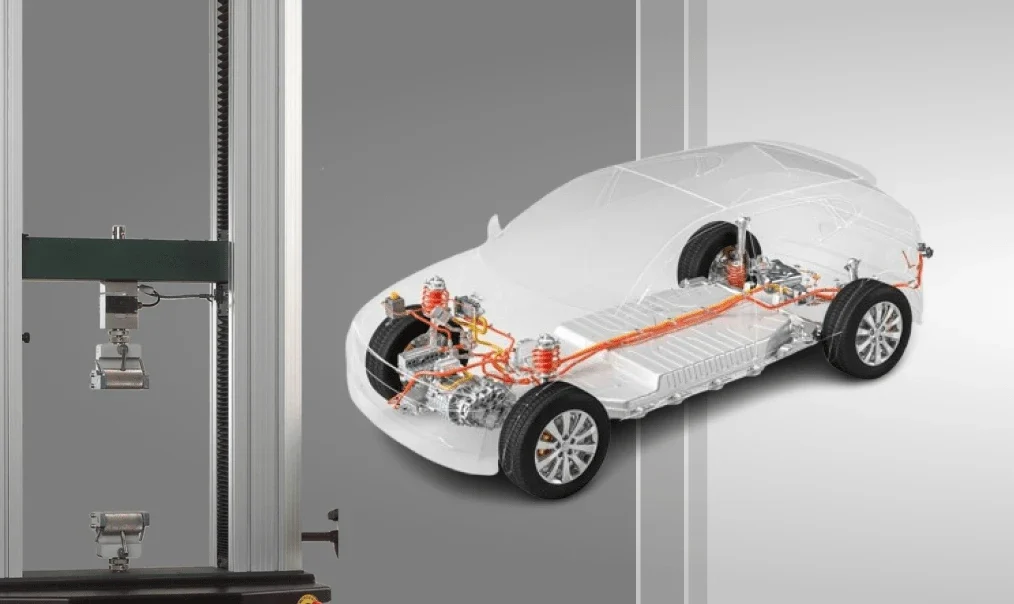
Electric vehicles depend on sturdy, reliable parts to run safely and efficiently. A Universal Testing Machine (UTM) helps manufacturers check how well these parts stand up to the everyday stresses of driving like pulling, pushing, or bending. By testing materials in a controlled setting, the UTM reveals potential weak spots before production, leading to better designs, improved safety, and longer-lasting components on the road.
By mirroring real-world conditions in a controlled lab environment, the UTM reveals how components will perform before they enter full-scale production. With this data, EV manufacturers can refine designs, improve safety, and prolong the life of key components ultimately creating more reliable, efficient vehicles for drivers everywhere.
Key Considerations
Key Considerations for Selecting a UTM Across Industries
ASTM
Standards
ISO
Standards

Sample Dimensions

Service & Supports

Test Speed & Control

Capacity & Force Range

Grips & Fixtures

Standard Software
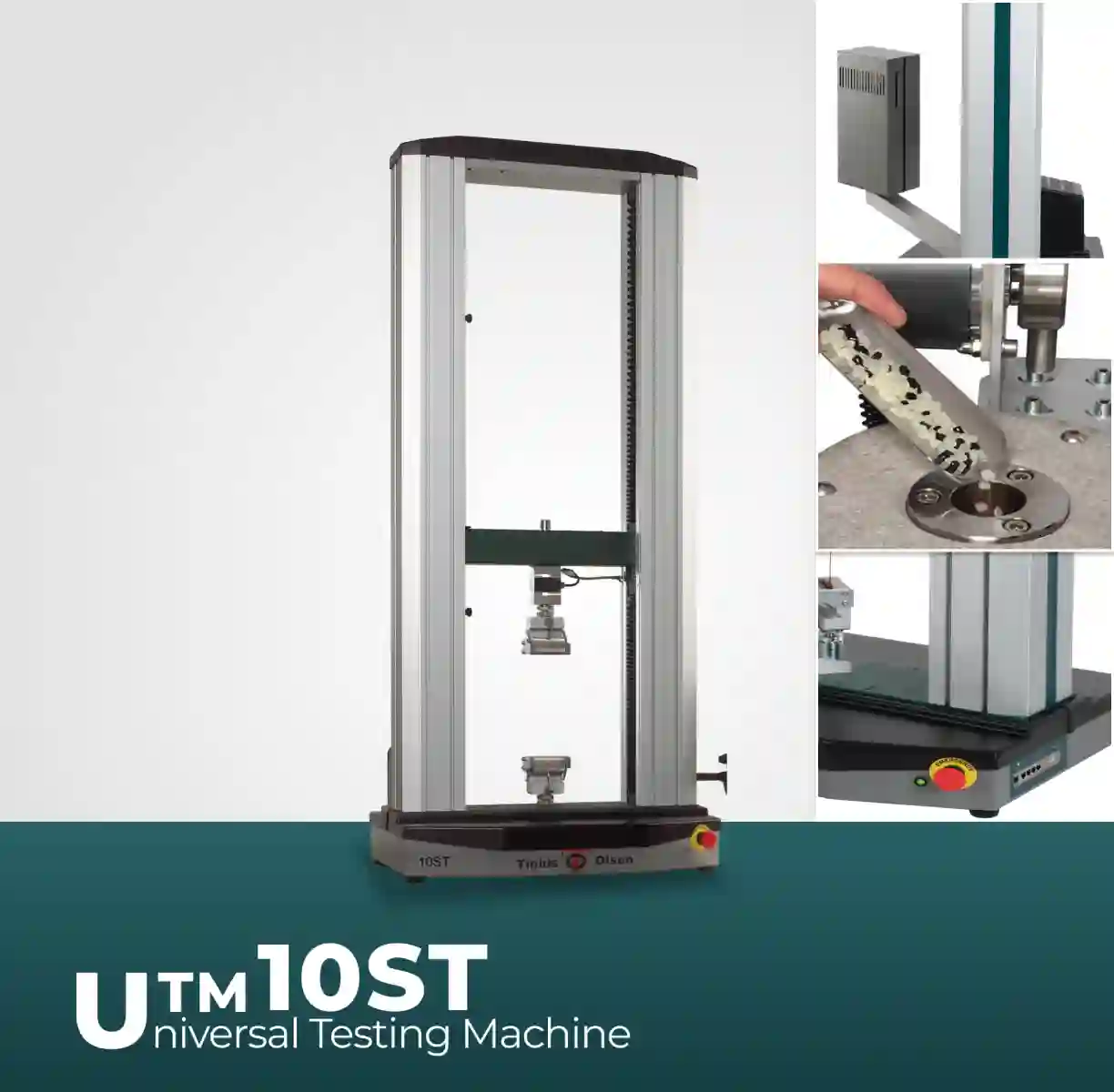
Model 10ST UTM
UTM 10ST is designed to assess the strength and reliability of EV components from battery casings to lightweight structural parts by applying tension, compression, and bending forces under controlled conditions. By revealing how materials behave before they hit the assembly line, the 10ST helps manufacturers refine designs, enhance safety, and improve overall vehicle performance in the rapidly evolving world of electric mobility.
Submit Your Details to Download Brochure!
Features
- Offers accurate tension and compression measurement to ensure even the smallest components meet strict safety and performance standards.
- Suitable for tension, compression, flexure, shear and other tests to a maximum force of 10kN/2000lbf
- All interface options integrate with Horizon data analysis software
- Eight full-length T slots built into the machine column to allow accessories to be securely mounted to the test frame.
- Various system interface options available, from a familiar tethered handheld interface, a wireless Bluetooth interface panel, or virtual machine controller.
Automotive test standards compliance
Verified compliance across international standards
INTERNATIONAL STANDARDS (ISO / ASTM)
ISO 527-3 | ASTM D882
Tensile strength of battery separator films
ISO 8295 | ASTM D1894
Friction of separator films for winding quality control
ISO 8510-2 | ASTM D903
Peel adhesion of electrode coatings on current collectors
ISO 6892-1 | ASTM E8
Aluminium/copper foil and busbar tensile properties
ISO 527-1/2 | ASTM D638
Battery enclosure and housing polymer components
ISO 527-4 | ASTM D3039
Lightweight CFRP/GFRP structural body panels
ISO 604 | ASTM D695
Compressive strength of battery cell enclosures & spacers
Submit Your Details to Download Brochure!
Select the right UTM for your specific requirements
Compare Flexitest universal testing machine models by load capacity, test speed, working area, dimensions and weight.
| Specification | Unit | 1ST | 5ST | 10ST | 25ST | 50ST | 100ST | 150ST | 300ST | 300SL |
|---|---|---|---|---|---|---|---|---|---|---|
| Capacity | kN | 1 | 5 | 10 | 25 | 50 | 100 | 150 | 300 | 300 |
| Capacity | lbf | 200 | 1,000 | 2,000 | 5,000 | 11,000 | 20,000 | 30,000 | 60,000 | 60,000 |
| Test speed range | mm/min | 0.0001–1000 | 0.0001–1000 | 0.0001–1000 | 0.0001–1000 | 0.0001–500 | 0.0001–500 | 0.0001–500 | 0.0001–500 | 0–76 |
| Test speed range | in/min | 0.000004–40 | 0.000004–40 | 0.000004–40 | 0.000004–40 | 0.000004–20 | 0.000004–20 | 0.000004–20 | 0.000004–20 | 0–3 |
| Clearance between columns | mm | - | - | 410 | 410 | 405 | 656 | 656 | 656 | - |
| Clearance between columns | in | - | - | 16 | 16 | 16 | 26 | 26 | 26 | - |
| Throat depth | mm | 100 | 100 | - | - | - | - | - | - | - |
| Throat depth | in | 4 | 4 | - | - | - | - | - | - | - |
| Maximum crosshead travel | mm | 755 | 755 | 1090 | 1090 | 1065 | 1198 | 1198 | 1173 | 648 |
| Maximum crosshead travel | in | 30 | 30 | 43 | 43 | 42 | 47 | 47 | 46 | 25.5 |
| Dimensions (H × W × D) | mm | 1168×511×467 | 1168×511×467 | 1625×729×506 | 1625×729×506 | 1655×729×506 | 2323×1160×700 | 2323×1160×700 | 2323×1160×700 | 1842×737×483 |
| Dimensions (H × W × D) | in | 46×20×18 | 46×20×18 | 64×29×20 | 64×29×20 | 65×29×20 | 91×46×28 | 91×46×28 | 91×46×28 | 72.5×29×19 |
| Weight | kg | 58 | 58 | 129 | 129 | 192 | 750 | 970 | 1050 | 1180 |
| Weight | lb | 128 | 128 | 284 | 284 | 423 | 1,653 | 2,138 | 2,315 | 2,600 |
* Nominal specifications shown for model comparison. Final configuration depends on the selected machine and application.
FAQ's
Frequently Asked Questions (FAQs) – Universal Testing Machines
What is a Universal Testing Machine used for in the electric vehicle industry?
A UTM applies controlled tensile, compression, flexure, peel and shear loads to EV materials and components. It tests battery separators, copper and aluminium foils, electrode coatings, enclosure metals, plastic housings, rubber seals and adhesive joints. Results per ASTM and ISO methods support R&D, supplier approval and production quality control across the EV supply chain.
Which standards apply to tensile testing of EV battery separator films?
Polymer separators are tested per ASTM D882 or ISO 527-3, which cover tensile strength and elongation of thin plastic films. Separators must survive winding during cell assembly, so these values are critical. Because separator film is anisotropic, specimens should be tested in both machine and transverse directions on a UTM fitted with film grips.
How are separator puncture resistance and friction tested on a UTM?
Puncture resistance is measured per ASTM F1306, where a probe is driven into a clamped film specimen. This indicates resistance to dendrites and electrode particles. Coefficient of friction is evaluated using ASTM D1894 or ISO 8295 as guidance, because separator-to-electrode friction affects winding quality. Both tests run on a UTM with the appropriate fixtures.
How is electrode coating adhesion tested on a Universal Testing Machine?
Electrode adhesion is commonly checked with 90° and 180° peel tests, where the coating is peeled from the current collector at a controlled angle. A tack test is another option for evaluating adhesion over a larger area. Delamination is a common battery failure mode, so these tests help compare binders, coatings and production batches.
Which standards govern tensile testing of battery foils and EV structural metals?
Thin copper and aluminium current collector foils are tested per ASTM E345. Battery enclosures, chassis components and tabs made of aluminium or steel follow ASTM E8 in North American specifications and ISO 6892-1 internationally. Both measure yield strength, tensile strength, elongation and modulus, helping verify that lightweight materials can absorb impact energy.
. How is a UTM used to test plastics used in EV components?
Plastics for interior parts, connector housings and covers are tested per ASTM D638 or ISO 527 using dumbbell specimens. The test reports tensile strength, elongation at break and tensile modulus. ASTM D638 is typically specified by North American buyers and ISO 527 by European and international customers. A UTM with an extensometer gives accurate modulus data.
Which standards apply to testing rubber seals and gaskets for EVs?
Rubber seals, gaskets and hoses are tested per ASTM D412 or ISO 37 for tensile strength, elongation at break and stress-strain behaviour. In EVs these parts help protect battery packs and electronics from moisture and dust. Because rubber stretches several hundred percent, the UTM needs suitable grips and a high-elongation extensometer.
How are adhesive bonds in EV battery packs and body structures tested?
Adhesives are tested on a UTM using ASTM D1002 for lap shear strength of bonded metals, ASTM D1876 for T-peel resistance, and ASTM D903 for peel or stripping strength of adhesive bonds. These methods compare adhesive performance, surface preparation and ageing effects. Results are comparative, so they should be paired with component-level validation.
How do I select the right load cell and grips for EV material testing?
Match the load cell to the material. Thin separators and foils need low-capacity load cells with film or pneumatic grips, while enclosure metals per ASTM E8 need much higher capacity. Adhesive lap shear per ASTM D1002 commonly falls between about 1 kN and 30 kN. An undersized load cell risks overload and an oversized one loses accuracy at low forces.
How should a UTM used for EV testing be calibrated?
Force measurement should be verified per ISO 7500-1, which classifies static uniaxial testing machines by accuracy. Crosshead speed, extensometer accuracy and grip alignment should also be checked regularly. Calibration records should meet ISO 17025 traceability requirements. Flexitest supports
Related Machines

Climate and temperature test chambers for EV batteries, proving cell and module safety under extreme heat, cold and rapid climate changes.
View Details →
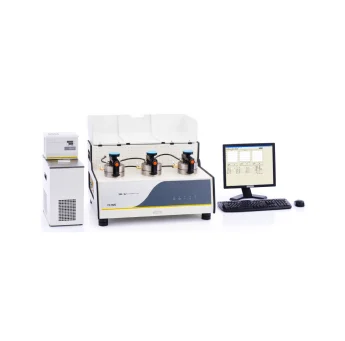
Two-cell vacuum method gas permeability tester for measuring oxygen, carbon dioxide and nitrogen transmission through films and sheets.
View Details →
Labthink C130H measures gas transmission, solubility and diffusion coefficients of films and sheets by the differential pressure method.
View Details →
NEWARE battery cyclers run controlled charge and discharge cycles on cells and modules to measure capacity, life and EV battery performance.
View Details →