
Permeability Testing Instruments

Determine the Shelf Life of Your Package with Our
Barrier Testing Instruments from Labthink
Barrier films are coatings or multilayer plastic blends that reduce water vapour and gas diffusion into and out of rigid and flexible packages. Our Permeation Analyzers have the most trusted repeatability in the market so that you are confident that your barrier films from different batches are of good quality and meet specified barrier levels. Our instruments are designed for testing permeation of rigid and flexible barriers.
Key Considerations
Key consideration for choosing the right permeability barrier tester.

Permeability Testing Machine Solutions


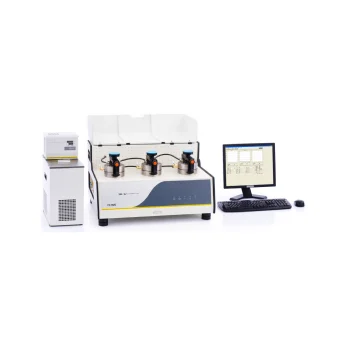

Select the right product for your specific requirements
Labthink Oxygen Transmission Rate (OTR) Tester Comparison
← Swipe to compare all specifications →
| Model | Type | Test range | Resolution | Repeatability / Accuracy | Temperature | Humidity | Cells / Cups | Specimen size |
|---|---|---|---|---|---|---|---|---|
| OTR | Oxygen Transmission Rate — cc/(m²·day) · ASTM D3985 · ISO 15105-2 · DIN 53380-3 | |||||||
| C203H | OTR · Sensor | 0.01–200 cc/(m²·day) | 0.0001 | 0.01 or 1%, whichever greater | 15–50°C ±0.05°C; 5–60°C opt. | 0%; 5%–90% RH ±1% | 3 cells; 3 results | 11.2 × 11.2 cm |
| WVTR | Water Vapour Transmission Rate — g/(m²·day) · ISO 15106-2 · ASTM F1249 | |||||||
| C303H | WVTR · Infrared sensor | 0.005–40 std; 0.005–100 opt. | 0.0001 | 0.005 or 2%, whichever greater | 15–50°C ±0.05°C; 5–60°C opt. | 5%–90% RH ±1% | 3 cells; 1–3 results | 11.2 × 11.2 cm |
| Combo | OTR + WVTR Combo Testers — cc & g/(m²·day) combined | |||||||
| C403H | OTR + WVTR · 3 cells | OTR: 0.01–200; WVTR: 0.005–40 | 0.0001 | OTR: 0.01 or 1%; WVTR: 0.005 or 2%, whichever greater | 15–50°C ±0.05°C; 5–60°C opt. | OTR: 0%; 5%–90% RH ±2%; WVTR: 0%; 5%–90% RH ±2% | 3 cells; 3 results | 11.2 × 11.2 cm |
| C406H | OTR + WVTR · 6 cells | OTR: 0.02–200; WVTR: 0.02–40 | 0.0001 | OTR: 0.02 or 1%; WVTR: 0.02 or 2%, whichever greater | 15–50°C ±0.15°C; 5–60°C opt. | OTR: 0%; 5%–90% RH ±2%; WVTR: 0%; 5%–90% RH ±2%; 100% | 6 cells; 6 results | 11.7 × 11.7 cm |
| Gas | Gas Permeability Testers — cc/(m²·day·Pa) · ISO 15105-1 · ASTM D1434 | |||||||
| C130H | Gas permeability · 3 cells | Confirm with Flexitest | Confirm with Flexitest | Confirm with Flexitest | Confirm with Flexitest | Confirm with Flexitest | 3 cells | Confirm with Flexitest |
| VAC-V2 | Gas permeability · 2 cells | Confirm with Flexitest | Confirm with Flexitest | Confirm with Flexitest | Confirm with Flexitest | Confirm with Flexitest | 2 cells | Confirm with Flexitest |
| Gravimetric | WVTR Gravimetric Cup Method — g/(m²·day) · ISO 2528 · ASTM E96 | |||||||
| C360H | WVTR · Gravimetric · 12 cups | Water: 0.01–10,000/n (1–12); Desiccant: 0.01–1,200 | 0.0001 g | Not specified | 20–55°C ±0.2°C | 10%–90% RH ±1% | 12 cups; 1–12 results | 50 cm² per cup |
Shared specs: Max. specimen thickness ≤3 mm; standard test area 50 cm². Gas permeability specs — confirm with Flexitest for C130H and VAC-V2.
OTR — Oxygen Transmission Rate
WVTR — Water Vapour Transmission Rate
Combo — OTR + WVTR
Gas Permeability Testers
WVTR Gravimetric Cup Method
FAQs
Frequently Asked Questions (FAQs) – Permeability Testing Instruments
What are permeability testing instruments?
Permeability testing instruments measure how gases, oxygen, and water vapor pass through packaging materials to evaluate barrier performance and protect product quality.
What is OTR (Oxygen Transmission Rate) testing?
OTR testing measures the amount of oxygen that penetrates a packaging material over time, helping manufacturers prevent oxidation and extend product shelf life.
What is WVTR (Water Vapor Transmission Rate) testing?
WVTR testing determines how much moisture vapor passes through a material under controlled temperature and humidity conditions to ensure effective moisture protection.
Why are permeability tests important for packaging?
Permeability testing helps prevent oxygen and moisture ingress that can cause spoilage, contamination, and reduced shelf life in food, pharmaceutical, and medical products.
What is the difference between OTR and WVTR?
OTR measures oxygen permeability, while WVTR measures moisture permeability. Both tests are essential for evaluating the overall barrier performance of packaging materials.
Which materials can be tested using permeability testers?
Materials such as plastic films, multilayer laminates, metalized films, paperboard, flexible packaging, rigid containers, and coated substrates can be tested.
What industries use permeability testing instruments?
Industries including food packaging, pharmaceuticals, medical devices, electronics, FMCG, and research laboratories rely on permeability testing for quality assurance.
What standards are used for OTR and WVTR testing?
Common standards include ASTM D3985, ASTM F1249, ASTM E96, ISO 15105, and ISO 15106, ensuring accurate and globally recognized results.
What factors affect permeability test accuracy?
Temperature, humidity, material thickness, pressure conditions, calibration, and proper sample preparation significantly influence testing accuracy.
How do permeability tests help extend product shelf life?
By identifying materials with strong oxygen and moisture barriers, permeability testing reduces oxidation and moisture exposure, helping preserve freshness and product stability.
