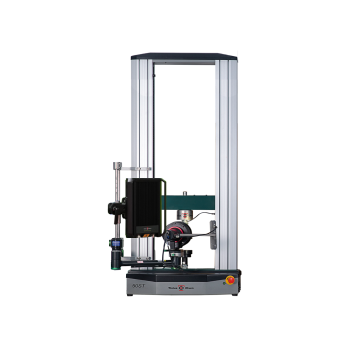

Paint / Coating / Metals Universal Testing Machine

  1. Home
  2. Paint /Coating/ Metals
  3. UTM paint coating
paint-coating-UTM-50ST-100-ST-300-SL-Main-banner

Building Trust Through Every Material Test

Universal Testing Machine (UTM) is a cornerstone for quality assurance in the paint, coating, and metal industry. It evaluates the mechanical properties of materials, such as tensile strength, compression, and elongation, to ensure they meet industry standards. For coatings and paints, UTM helps assess adhesion, flexibility, and resistance to cracking under stress. In the metal industry, it verifies material strength, ductility, and performance under various loads, ensuring reliability in critical applications. By providing precise, reliable data, UTM enables manufacturers to develop durable, high-quality products that withstand harsh conditions.It drives innovation and ensures materials consistently meet the highest performance standards in these industries.

Key Considerations

Key Considerations for Selecting a UTM Across Industries

UTM ASTM Standards

ASTM
Standards

UTM ISO Standards

ISO
Standards

UTM Sample Dimensions

Sample Dimensions

UTM Service & Supports

Service & Supports

UTM Test Speed & Control

Test Speed & Control

UTM Capacity & Force Range

Capacity & Force Range

UTM Grips & Fixtures

Grips & Fixtures

UTM Standard Software

Standard Software

Edit Template

Paint and Coating Test Method References

Examples of tensile, peel and dedicated coating tests. Select the method, specimen preparation and equipment for your application.

UTM ISO Standards
UTM ASTM Standards

ISO 4624 | ASTM D4541

Pull-off testing of coating adhesion using method-specific apparatus.

ISO 8510-2 | ASTM D903

Peel resistance of adhesive bonds in prepared test specimens.

ISO 527-3 | ASTM D882

Tensile properties of thin plastic films and sheets.

ASTM D2370

Tensile strength, elongation and stiffness of organic coatings tested as free films.

ASTM D3359

Tape-test adhesion ratings for coatings on metal substrates using cuts in the film.

ISO 1519 | ASTM D522

Resistance of attached coatings to cracking during mandrel-bend testing.

ISO 6272 | ASTM D2794

Resistance of coated substrates to rapid deformation in impact tests.

Select the right UTM for your specific requirements

Compare Flexitest universal testing machine models by load capacity, test speed, working area, dimensions and weight.

← Swipe to see full table →
Universal testing machine specifications: 1ST to 300SL
Specification Unit 1ST 5ST 10ST 25ST 50ST 100ST 150ST 300ST 300SL
CapacitykN15102550100150300300
Capacitylbf2001,0002,0005,00011,00020,00030,00060,00060,000
Test speed rangemm/min0.0001–10000.0001–10000.0001–10000.0001–10000.0001–5000.0001–5000.0001–5000.0001–5000–76
Test speed rangein/min0.000004–400.000004–400.000004–400.000004–400.000004–200.000004–200.000004–200.000004–200–3
Clearance between columnsmm--410410405656656656-
Clearance between columnsin--161616262626-
Throat depthmm100100-------
Throat depthin44-------
Maximum crosshead travelmm755755109010901065119811981173648
Maximum crosshead travelin303043434247474625.5
Dimensions (H × W × D)mm1168×511×4671168×511×4671625×729×5061625×729×5061655×729×5062323×1160×7002323×1160×7002323×1160×7001842×737×483
Dimensions (H × W × D)in46×20×1846×20×1864×29×2064×29×2065×29×2091×46×2891×46×2891×46×2872.5×29×19
Weightkg585812912919275097010501180
Weightlb1281282842844231,6532,1382,3152,600

* Nominal specifications shown for model comparison. Final configuration depends on the selected machine and application.

FAQ's

 Frequently Asked Questions (FAQs) – Universal Testing Machines

A Universal Tensile Testing Machine (UTM) applies controlled tensile, compressive, bend, peel, and shear forces to evaluate mechanical properties of materials. Flexitest UTMs support a wide range of global standards including ASTM D638, ASTM D882, ASTM E8, ASTM D412, ASTM D5034, ASTM D828, ASTM F88, ISO 527, ISO 6892-1, ISO 37, ISO 13934, and ISO 1924 – covering plastics, metals, rubber, textiles, paper, and packaging materials.

ASTM D638 covers tensile properties of plastics under defined specimen preparation, conditioning and test conditions. ISO 527-1 sets out general principles, while ISO 527-2 specifies conditions for moulding and extrusion plastics. Select the specimen, test speed, grips and strain measurement system required by the applicable method. Confirm the UTM configuration for the material and measurements required. Both are performed on a Flexitest UTM with appropriate grips and extensometer.

ASTM D882 covers tensile properties of plastic film and sheeting less than 1.0 mm thick. ISO 527-3 specifies tensile test conditions for plastic films and sheets. These are separate methods with their own requirements. Select the method specified for the material or application, then confirm specimen preparation, conditioning, grips, test speed and strain measurement for that method. A Flexitest UTM with film grips performs ASTM D882 testing accurately.

ASTM E8/E8M and ISO 6892-1 cover tensile testing of metallic materials at room temperature, including strength and ductility properties. Select the frame, load cell, grips and extensometer from the expected force, specimen geometry and chosen method. Elastic modulus measurement requires an appropriate method and strain measurement setup. Flexitest UTM models from 10 kN to 300 kN are suitable for metallic specimen testing.

ASTM D412 and ISO 37 describe tensile stress-strain testing of vulcanized rubber and thermoplastic rubber. Use the specimen geometry, test conditions and measurements specified by the selected method. Choose grips, load-cell range and elongation measurement equipment to suit the specimen and expected extension, and confirm the UTM configuration before testing. Flexitest UTMs with rubber grips and appropriate load cells support both ASTM D412 and ISO 37 testing.

ASTM D828 and ISO 1924-2 describe tensile testing of paper and paperboard using constant-rate-of-elongation equipment. Depending on the method, results include tensile strength, stretch or strain at break, and tensile energy absorption. These methods do not cover combined corrugated board; ISO 1924-2 can be used for its component papers. The specimen, grips and measurement range must meet the selected method. A Flexitest UTM with flat-face grips and appropriate load cell performs these tests accurately.

ASTM D5034 covers grab and modified-grab testing for breaking strength and elongation of textile fabrics, with material-specific limitations. Its grab procedure includes woven, nonwoven and felted fabrics. ISO 13934-2 determines maximum force by the grab method, mainly for woven fabrics, and is not normally applicable to nonwovens. Select the method according to fabric construction and follow its specimen, conditioning, gripping and machine requirements. Both tests are performed on a Flexitest UTM using textile grips with a constant crosshead speed.

ASTM F88/F88M measures the strength of seals in flexible barrier materials by recording the force required to separate a test strip containing the seal. It includes unsupported, supported 90-degree and supported 180-degree techniques; select and report the technique used. Seal strength is one characteristic of a package seal. Package integrity and applicable medical-packaging validation requirements need their own appropriate evaluations.

Choose the load frame and load cell based on the anticipated maximum force, material properties, specimen dimensions and applicable test method. Confirm that the forces you need to measure fall within the verified measurement range of the selected load cell at the required accuracy. Test loads must remain within the rated capacities of the frame, load cell, grips, fixtures and adapters. Share your specimen details and test requirements with Flexitest to confirm the force range, grips, fixtures and configuration.

Calibration and verification requirements depend on the test method and measurement systems used. ISO 7500-1 addresses static force-measuring systems. Other measurements may require separate verification. ISO/IEC 17025 concerns laboratory competence. Where NABL-accredited calibration is required, confirm that the current laboratory scope covers the relevant measurement and range. Flexitest provides NABL-traceable UTM calibration services across all models and capacity ranges.

Edit Template
×
Highlights
Scroll to Top
Flexitest logo