
Plastic and Polymer Testing Equipment
- Home
- Plastic and Polymer

- ASTM & ISO Certified Instruments
- Tinius Olsen Authorised Dealer
- Sartorius Authorized Partner
- Binder Drying Chambers
- Free Installation + AMC
- Calibration Certificates Included
- Pan-India Network
Why Rigorous Testing Matters
Why Plastic & Polymer QC Managers Can't Afford Testing Gaps
Every plastic manufacturing facility in India faces the same QC challenge – the material that looked fine in the hopper caused rejects on the line. These are documented, recurring failure modes that calibrated testing instruments prevent.
Out-of-Spec Resin Reaching the Production Floor
A polymer batch with the wrong Melt Flow Index causes film breaks in extrusion, short shots in injection moulding, and inconsistent wall thickness in blow moulding - discovered after production runs, not before. An MFI test takes 10 minutes and costs nothing compared to a scrapped run.
Mechanical Failures with No Test Evidence
A plastic bracket, housing, or pipe fitting fails in service. Without documented tensile, flexural, or impact data, you cannot differentiate a material fault from a processing fault from a design fault. Without a UTM and impact tester, every field failure is a guessing game.
Heat-Related Failures Near Processing Temperatures
A plastic component that performs at room temperature deforms at 80°C in service - because HDT and Vicat data was never measured. For automotive, electrical, and industrial applications, undocumented thermal limits are a regulatory and liability exposure.
Processing Defects from Undried Resin
Bubbles, splay marks, silver streaks, and weld line failures in moulded parts are routinely caused by excess moisture in hygroscopic resins - PET, PA, PC, ABS, PBT. A 3-minute moisture check before the batch enters the hopper eliminates the entire failure category.
Colour Rejections from OEM Customers
A batch of coloured plastic components is rejected for a ΔE of 1.8 - outside the customer's specification of ΔE ≤ 1.0. Without a spectrophotometer, you cannot measure, document, or dispute the rejection. With one, you screen every batch before it ships.
Audit Failures from Missing Instrument Data
OEM audits, BIS certifications, and export submissions require documented, calibrated test data. "We test visually" or "we rely on supplier data sheets" are audit failure answers. ASTM and ISO certified instruments with traceable certificates are the only acceptable response.
Driving Polymer Innovation with Accurate Testing
Plastics and polymer industry is a dynamic global sector that transforms raw materials into versatile products used across multiple industries, including automotive, packaging, electronics, construction, and healthcare.
Flexitest stands out as a comprehensive solution provider with an extensive range of advanced testing instruments that are critical to polymer material development and quality assurance. An extensive range of testing equipment enables comprehensive evaluation and verification of material properties necessary for accurate material data sheets.
This includes Melt Flow Testers and HDT / Vicat Testers for assessing thermal properties, Universal Testing Machines for tensile, compression, and flexural testing, and Charpy and Izod Pendulum systems for puncture impact and tensile impact testing.
These instruments are essential for ensuring materials meet industry standards and performance requirements.
At Flexitest, we are committed to empowering the plastic and polymer industry with reliable and comprehensive material testing solutions. By addressing the specific needs of manufacturers, we enable them to achieve superior product performance, durability, and safety.
Submit Your Details to Download Brochure!

Complete Product Portfolio
Precision Testing Equipment for the Plastic & Polymer Industry
Flexitest provides globally certified testing solutions designed for the modern polymer lab. Ensure your materials meet strict ASTM & ISO standards with our high-precision instruments, sourced from world-class manufacturers

One instrument for tensile, flexural, compressive, peel, and shear testing of all plastics and polymers. Tinius Olsen ST Series – Horizon software, ASTM E4 certified load cells. Delivers OEM-ready mechanical data for every material approval submission.
- ASTM D638
- ASTM D790
- ISO 527
- ISO 178

Measures MFR and MVR of all thermoplastics – PE, PP, PET, PA, PC, ABS – in 10 minutes. Catches out-of-spec resin batches before they cause film breaks or moulding defects. FRR-capable for recycled polymer qualification.
- ASTM D1238
- ASTM D1238
- ISO 1133-1
- ISO 1133-2

Detects moisture in resins, granules, and masterbatches in 2–5 minutes before extrusion or moulding. Prevents bubbles, splay marks, and weld line failures in finished parts. Sartorius MA160 – resolution to 0.001%, meets PET and PC grade specifications.
- LOD Principle
- ASTM 6980

Measures fracture energy – the toughness data every OEM material approval requires. One combined instrument performs Charpy (ISO 179) and Izod (ASTM D256) methods. Pendulum energies 1J to 50J cover all polymer grades.
- ASTM D256
- ASTM D6110
- ISO 179
- ISO 180

Measures the exact temperature at which plastics deflect under load (HDT) or soften without load (Vicat). Combined instrument – ASTM D648, D1525 / ISO 75, ISO 306. Multiple simultaneous test positions for fast thermal qualification.
- ASTM D648
- ASTM D1525
- ISO 75
- ISO 306

Measures CIE Lab* values and delivers a quantitative ΔE pass/fail result for every batch before it ships. Prevents OEM colour rejections and masterbatch supplier disputes. Spectrophotometer for standard-setting – colorimeter for production QC.
- CIE L*a*b*
- ASTM D2244
- ISO 7724

Pre-dry hygroscopic resins, condition test specimens to ASTM D618 / ISO 291, and run thermal stability tests – all in one instrument. Binder FD Series – ±0.5°C forced convection uniformity. DIN 12880 compliant.
- ASTM D3078
- ASTM F88
- ISO 11607

Simulates years of UV exposure, temperature cycling, and moisture in weeks. UV fluorescent (ASTM G154) for screening – Xenon arc (ASTM G155) for OEM exterior approval.
- ASTM G154
- ASTM G155
- ISO 4892-3
- ISO 4892-2
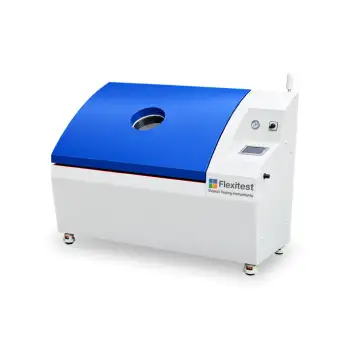
The chamber is built with a titanium inner cabinet, PID-controlled air heating and a peristaltic pump spray system. That combination keeps temperature and fog fall-out steady for long test cycles, so your results match the standard and hold up in customer and third-party audits.
- ASTM B117
- ISO 9227
- ISO 7253
Industries We Serve
Who Uses Plastic & Polymer Testing Instruments
From raw material producers to finished goods manufacturers – every stage of the polymer supply chain requires rigorous, documented testing.
Automotive Components
Tensile, impact, HDT & colour testing for dashboards, bumpers, door panels, under-hood components, seals & structural plastic parts - for OEM material approvals.
Packaging & Film Manufacturers
MFI for resin QC, UTM for film tensile testing, moisture analysis before extrusion - for film converters, blow moulders & container manufacturers.
Electronics & Consumer Goods
Colour consistency, impact strength & thermal stability for housings, connectors & structural plastic components in electronics, appliances & consumer goods.
Construction & Piping
MFI, HDT, tensile & weathering testing for CPVC/UPVC pipes, fittings, profiles & outdoor construction plastic components. BIS certification support.
Medical & Pharma Devices
Tensile, impact & HDT testing for medical-grade polymers in syringes, IV components, diagnostic housings & pharmaceutical packaging.
Masterbatch & Compounding
MFI, colour measurement & moisture analysis for masterbatch producers to qualify consistency, colour accuracy, processability & additive effectiveness.
Compliance & Standards
Testing Standards We Support
All instruments calibrated to internationally recognised standards. We assist with method selection, configuration & audit-ready documentation.
Customer Testimonials
Trusted by Labs Across India



FAQ's
Frequently Asked Questions (FAQs) – Common questions from QC managers, procurement officers, and R&D teams.
Which plastic & polymer testing instruments does a complete QC lab need?
A complete plastics QC lab requires 8 core instruments: (1) UTM – tensile, flexural & compressive testing (ASTM D638, D790, D695); (2) Melt Flow Indexer – incoming resin qualification (ASTM D1238); (3) HDT/Vicat Tester – thermal performance data (ASTM D648, D1525); (4) Charpy & Izod Impact Tester – toughness qualification (ASTM D256, D6110); (5) Moisture Analyser – pre-processing resin moisture check (Sartorius MA160); (6) Colour Measurement – batch colour consistency; (7) Drying & Heating Chambers – resin pre-drying and sample conditioning (Binder); (8) Accelerated Weathering Chamber – UV outdoor durability. Flexitest supplies all 8 with free on-site installation, calibration certificates, and AMC support across India.
What is the Melt Flow Index test and why is it critical for plastic manufacturing?
The Melt Flow Index (MFI) test measures how easily a thermoplastic polymer flows when melted – expressed as grams extruded per 10 minutes (MFR) or volume per 10 minutes (MVR) under defined temperature and load (ASTM D1238 / ISO 1133). MFI tests plastic flow to ensure quality moulding and smooth, consistent production. An out-of-spec MFI causes film breaks in extrusion, short shots in injection moulding, and inconsistent wall thickness in blow moulding – all discovered after production runs, not before. A 10-minute incoming batch test with the Tinius Olsen MP1200 catches deviations before they reach the production floor.
What is the difference between Charpy and Izod impact testing for plastics?
In Charpy testing (ISO 179 / ASTM D6110), the specimen is horizontal and supported at both ends – the pendulum strikes the centre. In Izod testing (ISO 180 / ASTM D256), the specimen is vertical and clamped at the base – the pendulum strikes the free end. Both measure impact energy absorbed during fracture but differ in specimen orientation and applicable standards. Many industries require both methods – Flexitest supplies combined Charpy/Izod instruments that perform both from a single machine.
What is the difference between HDT and Vicat Softening Point testing?
HDT (ASTM D648 / ISO 75) measures the temperature at which a plastic specimen deflects by 0.25 mm or 2 mm under a specified flexural load in a liquid bath – indicating the maximum use temperature under load. Vicat Softening Point (ASTM D1525 / ISO 306) measures the temperature at which a 1 mm² needle penetrates 1 mm into the specimen under a standardised load – indicating softening temperature without a bending load. HDT is used for structural applications; Vicat is used for material characterisation. Both tests are available on combined HDT/Vicat instruments supplied by Flexitest.
Why must polymer resins be dried before extrusion or injection moulding?
Moisture in hygroscopic polymers – PET, PA (Nylon), PC, ABS, PBT – causes hydrolytic degradation during processing, leading to bubbles, surface defects, splay marks, reduced molecular weight, and poor mechanical properties in the finished product. For PET, moisture must typically be below 50–200 ppm before processing. The Sartorius MA160/MA100 Moisture Analyser gives results in minutes using the Loss-on-Drying (LOD) method with halogen or infrared heating – fast, accurate, and suitable for all resin types.
Which ASTM and ISO standards apply to plastic and polymer testing instruments?
Yes. Every instrument supplied by Flexitest includes a factory calibration certificate traceable to international standards, plus method documentation for the applicable ASTM/ISO/BIS standard. AMC contracts include scheduled calibration visits. Standalone traceable calibration certificates are also available for audit purposes.
How do Accelerated Weathering Chambers predict outdoor durability of plastics?
Accelerated weathering chambers expose plastic specimens to UV radiation, elevated temperature, and moisture condensation in programmable cycles – compressing years of real outdoor exposure into weeks. Effects measured include colour change (ΔE), gloss loss, chalking, embrittlement, and tensile strength reduction. UV Fluorescent Chambers (ASTM G154 / ISO 4892-3) use UVA-340 or UVB-313 lamps for cost-effective comparative material screening. Xenon Arc Chambers (ASTM G155 / ASTM D2565 / ISO 4892-2) simulate the full solar spectrum – required for most automotive OEM exterior component approval specifications. Flexitest supplies both types with test cycle setup support.
Why is colour measurement important in plastic manufacturing?
Colour is a measurable quality parameter in plastic manufacturing – not just an aesthetic preference. Inconsistent colour causes OEM customer rejections, retail failures, and masterbatch supplier disputes. Colour is measured in the CIE L*a*b* system (ASTM D2244), giving numerical values for lightness (L*), red-green (a*), and yellow-blue (b*). The colour difference (ΔE) against a master standard determines pass or fail. Typical OEM limits: automotive exterior ΔE ≤ 0.5; electronics ΔE ≤ 1.0; consumer goods ΔE ≤ 1.5–2.0. A spectrophotometer is recommended for colour standard setting; a colorimeter for routine production QC checks.
What are Binder Drying Chambers used for in a polymer testing and processing lab?
Binder Drying and Heating Chambers serve three critical functions: (1) Resin pre-drying – removing moisture from hygroscopic resins (PET, PA, PC, ABS, PBT) to below processing specification before extrusion or moulding. (2) Sample conditioning – ASTM D638, D790, D256 require specimens conditioned at 23°C ±2°C and 50% RH for 24–88 hours (ASTM D618 / ISO 291) before testing. In India’s variable climate, this ensures globally comparable, audit-ready results. (3) Thermal ageing testing – exposing specimens to elevated temperatures to validate thermal stabiliser effectiveness and qualify materials for high-temperature service. Binder FD Series (forced convection, ±0.5°C uniformity) is recommended for most polymer processing and QC labs.
What is the delivery and installation process for plastic testing instruments across India?
For standard stocked instruments, delivery is 2–4 weeks from order confirmation. Imported or customised instruments: 6–10 weeks. Flexitest manages logistics, import clearance, and last-mile delivery anywhere in India. A dedicated service engineer visits within 48 hours of instrument arrival for on-site installation, calibration, sample test run, and full operator training – at zero additional cost. Service engineers are based in Mumbai, Delhi, Ahmedabad, Vadodara, Pune, Hyderabad, and Chennai. Annual Maintenance Contracts (AMC) covering preventive maintenance, calibration, and emergency support are available for all instruments.