
Gas Permeability Tester
- Home
- EV Industry
- Gas Permeability Tester

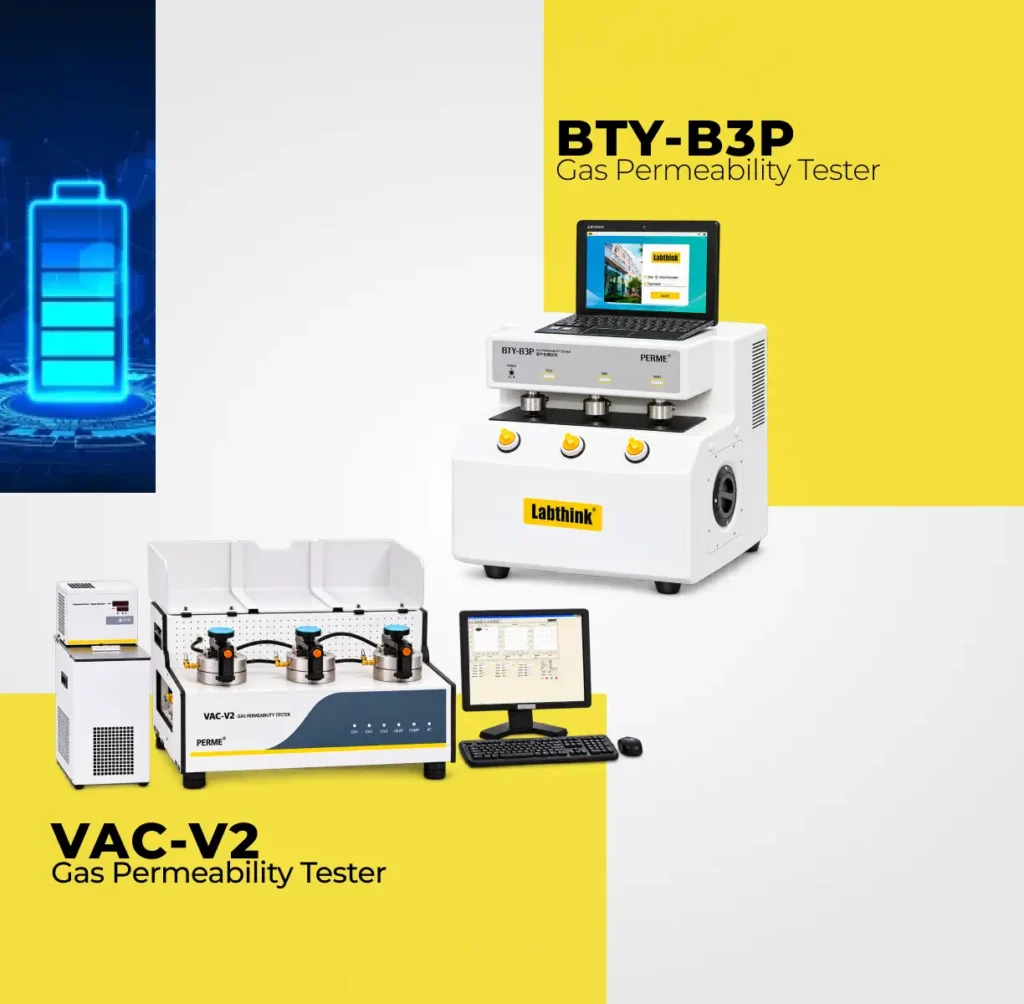
Ensuring Material Integrity in the EV Landscape
In the EV industry, maintaining the purity and stability of the battery environment is essential for performance and safety. The gas permeability tester provides a precise way to measure how much oxygen, nitrogen, or other gases pass through materials like battery casings, seals, and protective films. If the rate of gas transmission is too high, moisture and oxygen can infiltrate the battery’s interior, potentially causing corrosion, chemical imbalances, or even early battery failure.
By evaluating the permeability of films, seals, adhesives, and casings used around the battery, engineers ensure these materials maintain the right balance of protection and breathability. If too much moisture or oxygen infiltrates the battery enclosure, it can compromise longevity, safety, and overall performance. Through accurate gas permeability testing, the EV industry can confidently select materials that preserve battery integrity, minimize environmental risks, and enhance the reliability of electric vehicles on the road.
BTY-B3P Gas Permeability Tester

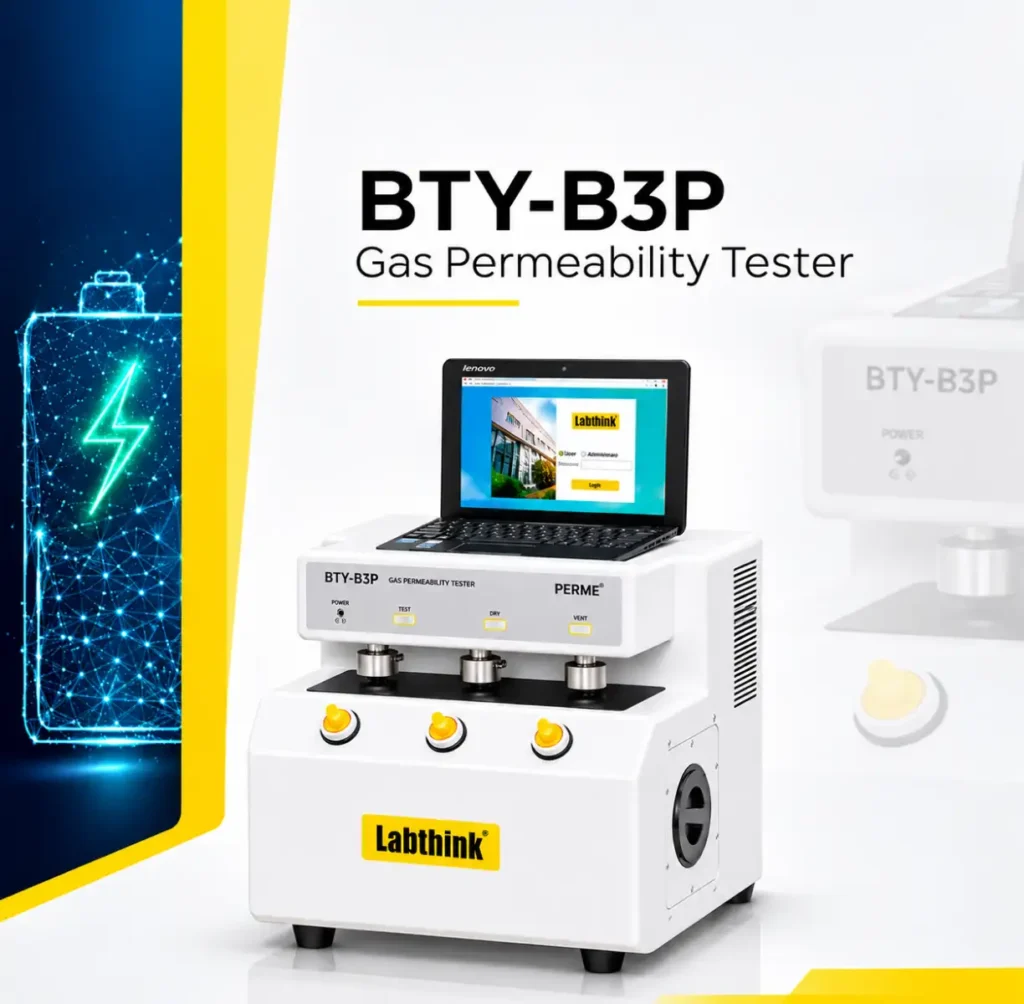

The BTY-B3P Gas Permeability Tester uses the differential pressure method to accurately measure how much gas passes through battery diaphragms, breathable films, and other polymer materials used in EV battery assemblies. In the electric vehicle industry, these insights are critical. By ensuring that only the right amount of gas or moisture can move through these materials, manufacturers can better protect the internal environment of the battery pack. This ultimately leads to more stable battery performance, longer battery life, and a more reliable driving experience for EV owners.
Submit Your Details to Download Brochure!
Features
- Touch screen, easy to learn and easy to operate
- 3 equivalent specimens can be tested simultaneously with the average value as test result
- Imported high precision pressure sensors are used, which guarantees the testing accuracy and repeatability
- The instrument is controlled by computer with automatic test process
- Environmental temperature and humidity are monitored and recorded in real time.
- Imported pneumatic control system with ultra-low failure rate and extremely long service life, which guarantees the seal performance of the whole system.
VAC-V2 Gas Permeability Tester

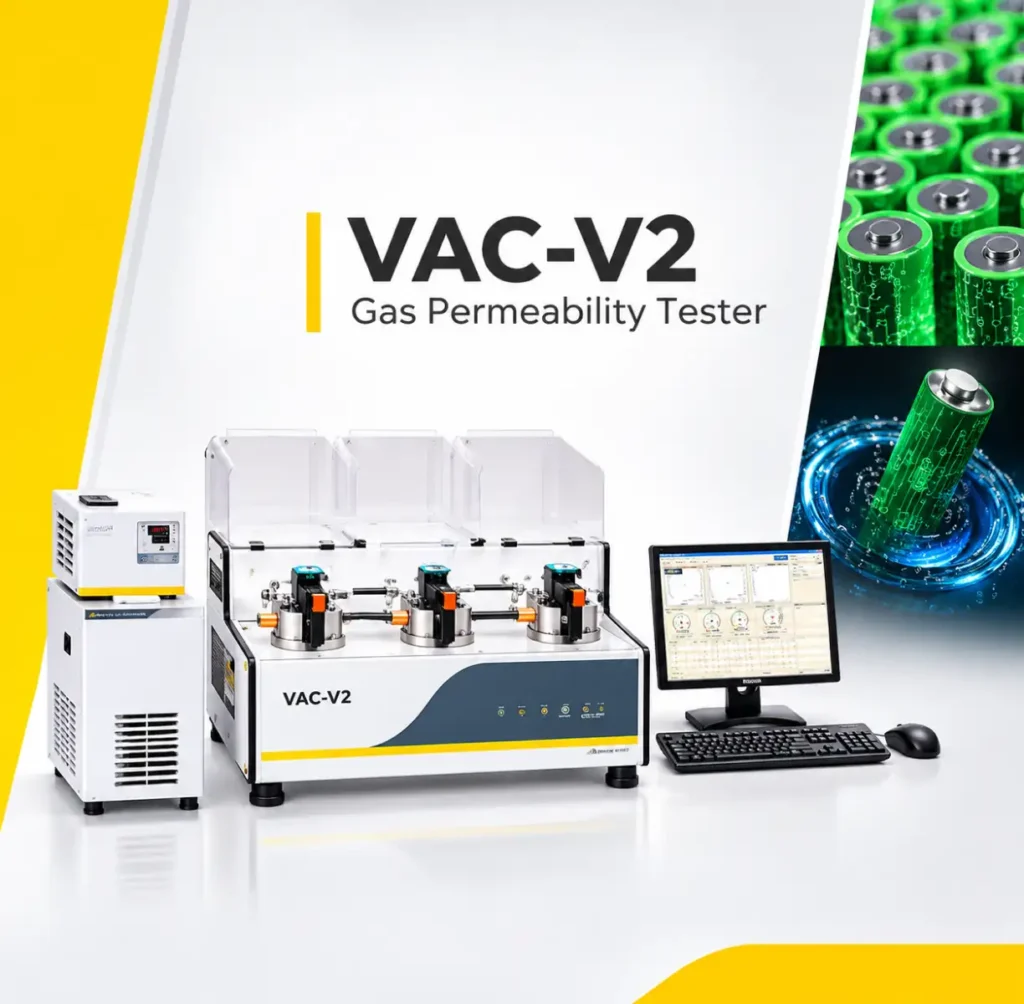
VAC- V2 transforms material testing in the EV industry, ensuring every component meets the demands of modern electric mobility. This advanced vacuum-based system meticulously measures gas permeability in vital elements like battery separators and protective films-key players in battery safety, efficiency, and longevity. By delivering precise insights, the VAC V2 empowers manufacturers to refine materials and optimize battery performance, paving the way for safer, more efficient, and longer-lasting EVs. It’s not just a testing machine; it’s the driving force behind the future of sustainable innovation.
Submit Your Details to Download Brochure!

Features
- Touch screen, easy to learn and easy to operate
- 3 equivalent specimens can be tested simultaneously with the average value as test result
- Imported high precision pressure sensors are used, which guarantees the testing accuracy and repeatability
- The instrument is controlled by computer with automatic test process
- Environmental temperature and humidity are monitored and recorded in real time.
- Imported pneumatic control system with ultra-low failure rate and extremely long service life, which guarantees the seal performance of the whole system.
FAQ's
Frequently Asked Questions (FAQs) – Gas Permeability Tester for EV Batteries (BTY-B3P / VAC-V2)
What is gas permeability testing and why does it matter for EV battery materials?
Gas permeability testing measures how much oxygen, nitrogen or other gas passes through materials such as battery diaphragms, casings, seals, protective films and adhesives. If transmission is too high, moisture and oxygen can enter the battery interior, risking corrosion, chemical imbalance and early failure. Testing helps engineers select materials that protect battery integrity and lifespan.
What is the differential pressure method and which standards define it?
In the differential pressure method, a test gas is applied to one side of the film and the amount passing to the low-pressure side is measured. ASTM D1434 defines a manometric method, and ISO 15105-1 specifies differential-pressure methods using a pressure sensor or a gas chromatograph. The BTY-B3P is based on this method.
Which standards are listed for the VAC-V2 gas permeability tester?
Flexitest lists ISO 15105-1, ISO 2556, ASTM D1434, JIS K7126-1 and YBB 00082003 for the VAC-V2 Gas Permeability Tester. ASTM D1434-23 and ISO 15105-1:2007 are the main international references for the differential-pressure gas transmission rate method, so test reports can support both North American and international customer requirements.
What is the difference between the BTY-B3P and the VAC-V2?
The BTY-B3P uses the differential pressure method to measure gas passing through battery diaphragms, breathable films and other polymer materials in battery assemblies, with test options for cylindrical and laminated battery materials. The VAC-V2 is a vacuum-based system for battery separators and protective films, with wide-range temperature control through a water bath.
Which materials can be tested on these gas permeability testers?
They test battery diaphragms and separators, breathable films, protective films, seals and other polymer materials used around the battery. ASTM D1434 covers plastic film, sheeting, laminates, and plastic-coated papers or fabrics. This makes the testers suitable for separators, pouch and laminate films and similar barrier layers used in EV battery assemblies.
How does gas transmission rate (GTR) differ from OTR and WVTR?
GTR measures the transmission of a single pure gas using the differential-pressure method, per ASTM D1434 and ISO 15105-1. Oxygen transmission rate (OTR) is measured per ASTM D3985 and ISO 15105-2 using an equal-pressure sensor method. Water vapour transmission rate (WVTR) is measured per ASTM F1249 and ISO 15106-2 using an infrared sensor.
What results does a gas permeability test report and how should they be interpreted?
ASTM D1434 determines gas transmission rate (GTR), permeance and, for homogeneous materials, permeability. A commonly used GTR unit is mL(STP)/(m²·d) at a pressure differential of one atmosphere. The standard notes that results are semiquantitative estimates and that correlation with real-world use must be determined by experience, so results are best used to compare materials and batches.
How do the testers deliver consistent, repeatable results?
Three equivalent specimens can be tested simultaneously, with the average used as the test result. Imported high-precision pressure sensors protect accuracy and repeatability, and a computer-controlled automatic process reduces operator influence. Environmental temperature and humidity are monitored and recorded in real time, which matters because ambient conditions can affect gas transmission measurements.
Why are temperature control and specimen conditioning important in gas permeability testing?
Gas transmission is influenced by conditions such as temperature and the moisture or solvent content of the specimen. ASTM D1434 describes drying specimens in a desiccator beforehand, and notes that the drying period may need to be longer for some materials. The VAC-V2 water bath gives wide-range, accurate temperature control for repeatable tests.
How should a gas permeability tester be calibrated and supported?
Pressure sensors, vacuum performance and temperature control should be verified regularly, with calibration records meeting ISO 17025 traceability requirements. Flexitest provides free installation and training, calibration, annual maintenance contracts (AMC) and live online troubleshooting. Branches in Mumbai, Delhi, Ahmedabad, Vadodara, Pune, Hyderabad and Chennai support labs across India.
Related Machines
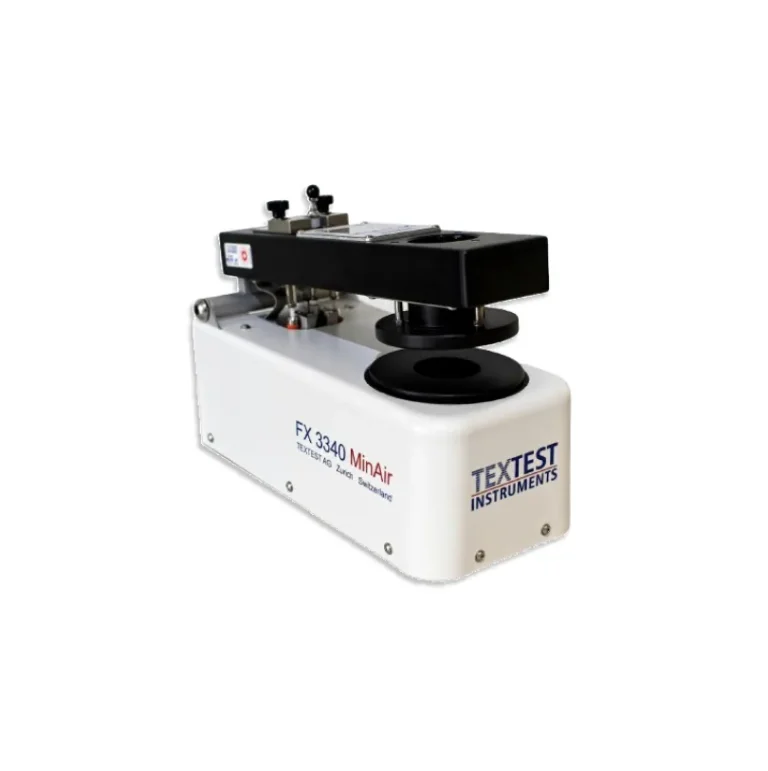
Explore Textest air permeability testers for fabrics and technical textiles. Compare laboratory and production options with guidance from Flexitest.
View Details →
NEWARE battery cyclers run controlled charge and discharge cycles on cells and modules to measure capacity, life and EV battery performance.
View Details →
Tinius Olsen UTM 10ST with 10 kN capacity for tensile, flexural and compression testing of plastics and polymer components to ISO and ASTM.
View Details →
Climate and temperature test chambers for EV batteries, proving cell and module safety under extreme heat, cold and rapid climate changes.
View Details →


