Accelerated Weathering Chamber

  1. Home
  2. Automotive
  3. Accelerated Weathering Chamber
Automotive material durability

Xenon and UV Weathering Chambers for Automotive Materials

Assess how automotive plastics, coatings and trim respond to light, heat and moisture. Compare xenon arc and fluorescent UV chambers, from benchtop instruments to larger sample capacities, and select a configuration around your customer’s test method.

Request a chamber recommendationShare the standard, cycle and sample size.
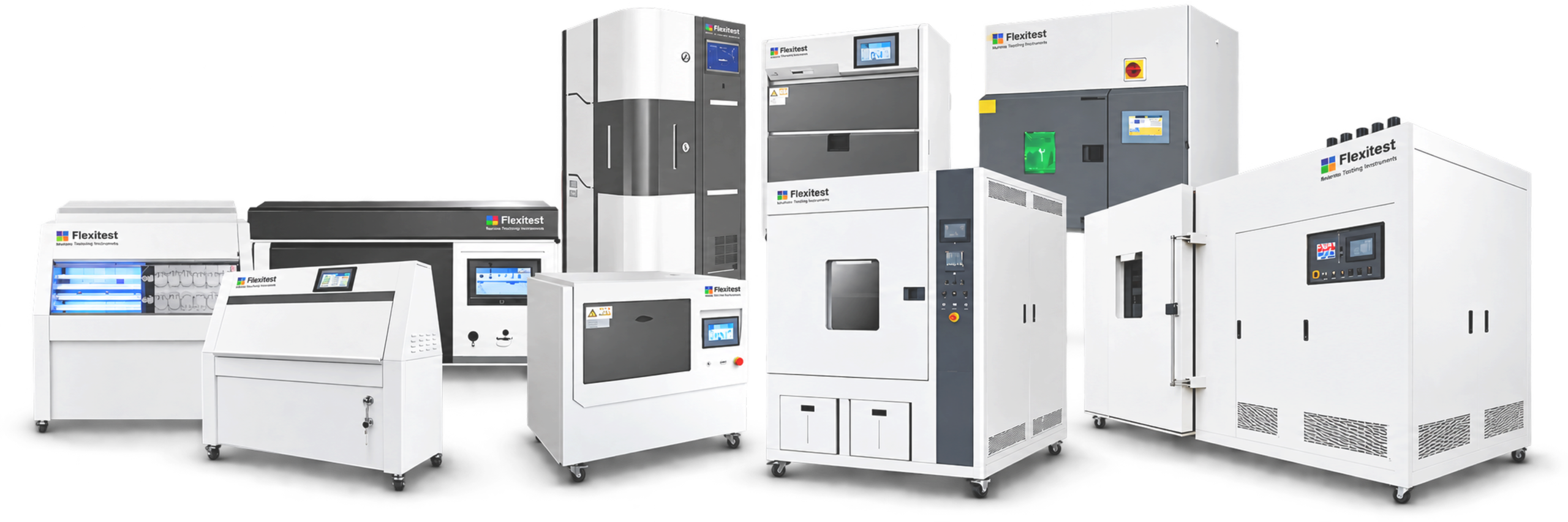
Accelereated weathring chamber scaled
Choose by standard, light and workload

Shortlist the right accelerated weathering tester

First match the chamber to the required exposure method. Then compare sample capacity, utilities and the controls named in your customer’s test cycle.

Listed capacities use flat 150 × 70 mm specimens. Controls and repeats occupy positions; shaped components and other holders can change usable capacity.

Testing Standards

Which Standard Might Your Customer Specify?

Standards give the laboratory a common way to run and report a test. The right one depends on the material, where it is used in the vehicle and the customer’s requirement. Here are the main references you may come across.

☀️ Xenon Arc
ASTM G155

Operating xenon arc exposure equipment - the foundational method for xenon weathering test setup and operation.

☀️ Xenon Arc
ISO 4892-2

Xenon exposure of plastics, including daylight and window-glass-filtered light conditions for interior and exterior applications.

☀️ Xenon Arc
ISO 16474-2

Xenon arc exposure of paints and varnishes - method for colour and appearance change measurement under solar-simulated conditions.

☀️ Xenon Arc
SAE J2412 / SAE J2527

Automotive interior trim (J2412) and exterior materials (J2527) - controlled-irradiance xenon arc methods widely specified by OEMs.

🔆 Fluorescent UV
ASTM G154 / ISO 4892-3

Fluorescent UV exposure equipment (G154) and UV exposure of plastics (ISO 4892-3) - UVA or UVB lamp, irradiance and cycle specified.

🔆 Fluorescent UV
ASTM D4587

UV and condensation exposure of paints and related coatings - fluorescent UV method for coating degradation and durability evaluation.

💡
Have a customer standard to meet? Share the standard, edition and required cycle with Flexitest. We'll check the proposed chamber's lamp, filter, controls and sample setup against that requirement before finalising the configuration. SAE and OEM programmes may also require specific equipment qualification.

Compare Xenon Weathering Chambers Specification

UV chambers · ST full-size UVA / UVB · SB benchtop UVA / UVB

← Swipe to compare all chambers →

Compare Xenon & UV Weathering Chambers
☀️ Xenon Arc Chambers
🔆 Fluorescent UV Chambers
Feature SX/1000Benchtop SX/6500/HFull-size ST/UV/AFull-size · UVA / UVB SB/UV/ABenchtop
Light source 1 × 1.8 kW air-cooled xenon lamp 1 × 6.5 kW water-cooled xenon lamp 8 × 40 W fluorescent UV lamps 3 × 20 W fluorescent UV lamps
Lamp options Filter-based — daylight, window-glass or other UVA 340 nm or UVB 313 nm UVA 340 nm or UVB 313 nm
Exposure area 1,000 cm² 6,500 cm²
Sample capacity 9 samples (150 × 70 mm) 63–65 samples (150 × 70 mm) 24 racks; 48 samples (150 × 70 mm) 18 samples (150 × 70 mm)
Sample arrangement Flat sample holder Rotating three-layer sample rack Flat sample racks Flat sample racks
Rated power 1.8 kW 6.5 kW 2 kW (max.) 1.2 kW
Power supply Confirm with Flexitest 220 V, 50 Hz; 60 Hz optional; max. 10 A 220 V, 50 Hz, 6 A
Dimensions (L × W × H) Confirm with Flexitest Confirm with Flexitest 1,360 × 560 × 1,290 mm 940 × 490 × 630 mm
Model details View SX/1000 → View SX/6500/H → View ST UVA / UVB → View SB/UV/A →

☀️ Xenon Arc

☀️
SX/1000
Xenon Arc — Benchtop Chamber
Light source1 × 1.8 kW air-cooled xenon lamp
Lamp optionsFilter-based — daylight or window-glass
Exposure area1,000 cm²
Sample capacity9 samples (150 × 70 mm)
Sample arrangementFlat sample holder
Rated power1.8 kW
Power supplyConfirm with Flexitest
DimensionsConfirm with Flexitest
Model detailsView SX/1000 →
☀️
SX/6500/H
Xenon Arc — Full-size Chamber
Light source1 × 6.5 kW water-cooled xenon lamp
Lamp optionsFilter-based — daylight or window-glass
Exposure area6,500 cm²
Sample capacity63–65 samples (150 × 70 mm)
Sample arrangementRotating three-layer sample rack
Rated power6.5 kW
Power supplyConfirm with Flexitest
DimensionsConfirm with Flexitest
Model detailsView SX/6500/H →
🔆
ST/UV/A
Fluorescent UV — Full-size · UVA / UVB
Light source8 × 40 W fluorescent UV lamps
Lamp optionsUVA 340 nm or UVB 313 nm
Exposure area
Sample capacity24 racks; 48 samples (150 × 70 mm)
Sample arrangementFlat sample racks
Rated power2 kW (max.)
Power supply220 V, 50 Hz; 60 Hz optional; max. 10 A
Dimensions1,360 × 560 × 1,290 mm
🔆
SB/UV/A
Fluorescent UV — Benchtop Chamber
Light source3 × 20 W fluorescent UV lamps
Lamp optionsUVA 340 nm or UVB 313 nm
Exposure area
Sample capacity18 samples (150 × 70 mm)
Sample arrangementFlat sample racks
Rated power1.2 kW
Power supply220 V, 50 Hz, 6 A
Dimensions940 × 490 × 630 mm
Model detailsView SB/UV/A →

* Confirm the filter, irradiance measurement band, moisture cycle and utilities for your test method before ordering. Capacity is based on flat sample size; confirm holders for shaped components.

FAQ's

Need help choosing a weathering chamber?Tell us your material, test method and sample size. We’ll help you compare the available configurations.

Start with the material and your customer’s specification. For plastics, ISO 4892-2 covers xenon-arc exposure and ISO 4892-3 covers fluorescent UV exposure. For paints and varnishes, ISO 16474-2 covers xenon exposure; ASTM D4587 covers fluorescent UV and condensation exposure of paints and related coatings.

ASTM G155 and ASTM G154 describe operating xenon and fluorescent UV apparatus respectively. The standard number is only part of the requirement: the specified cycle, exposure duration and method of assessing deterioration must also be agreed. This helps you select equipment that can run the test your customer actually needs.

SAE J2412 is for automotive interior trim; SAE J2527 is for exterior materials. Both use controlled-irradiance xenon-arc exposure. Dashboard and door-trim materials face a different environment from exterior mouldings or painted surfaces, so the filter and exposure cycle matter.

For an SAE or vehicle-manufacturer requirement, send Flexitest the exact standard, edition and material specification. We can review the proposed chamber configuration against the required controls and sample arrangement, including any equipment-qualification requirements. A general xenon capability should not be treated as automatic approval for a specific automotive programme.

Choose the exposure your test method calls for. Filtered xenon provides a broader light spectrum and is useful when colour and appearance changes under sunlight are central to the test. Fluorescent UV focuses on ultraviolet exposure and can help compare deterioration such as cracking or chalking in plastics and coatings.

For example, ISO 4892-2 calls for xenon exposure of plastics, while ISO 4892-3 uses fluorescent UV. UVA-340 and UVB-313 lamps also produce different spectra: they are not interchangeable shortcuts to a faster result. Match the lamp, filter and cycle to the specified method before comparing chamber size or price.

The Flexitest range includes both xenon and fluorescent UV options. Compare the SX/1000 benchtop xenon chamber and SX/6500/H for xenon-based requirements. For fluorescent UV exposure, compare the full-size ST chamber, available with UVA or UVB lamps, and the benchtop SB chamber.

The model choice depends on the complete test requirement, not just the standard’s name. Share the specified edition and cycle so Flexitest can check the lamp or filter, light-intensity control, temperature and moisture stages, and specimen holders. This review connects the required automotive application with a suitable chamber configuration before you place an order.

Ask for the complete exposure cycle. It should identify the lamp or optical filter, irradiance—the light intensity at the specimen—the temperature control, and any humidity, spray or condensation stages. Where the method specifies a black-panel or black-standard temperature sensor, confirm that requirement as well as the temperature setting.

Also agree the exposure endpoint and inspection intervals. Two reports labelled “ASTM G155” can describe different operating conditions, so their results are not automatically comparable. Recording the actual settings gives your laboratory and customer a clear basis for reviewing the test.

The customer’s specification or development plan sets the exposure endpoint. It may be expressed as elapsed hours or a specified radiant exposure—the accumulated light energy per unit area at the specimen—depending on the method. Agree this before testing, together with when samples will be inspected.

There is no universal conversion such as “1,000 chamber hours equals five years outdoors.” Material formulation, climate and the laboratory cycle all affect the relationship. Accelerated testing is valuable for comparing materials and checking a defined requirement; a service-life prediction needs supporting laboratory and outdoor evidence for the particular material.

Measure the changes that matter to the component’s end use. For visible trim or paint, this may mean colour change, gloss retention, chalking or cracking. For a plastic component, the programme may also require a check of strength or other relevant properties after exposure.

Record the starting condition and assess exposed specimens using the agreed methods. Include reference materials and repeat specimens where required. ASTM G155 and G154 do not provide one universal automotive pass/fail limit: acceptance criteria come from the applicable material specification or your customer. The chamber creates the exposure; the agreed evaluations establish the result.

Measure the changes that matter to the component’s end use. For visible trim or paint, this may mean colour change, gloss retention, chalking or cracking. For a plastic component, the programme may also require a check of strength or other relevant properties after exposure.

Record the starting condition and assess exposed specimens using the agreed methods. Include reference materials and repeat specimens where required. ASTM G155 and G154 do not provide one universal automotive pass/fail limit: acceptance criteria come from the applicable material specification or your customer. The chamber creates the exposure; the agreed evaluations establish the result.

Request a chamber recommendation

Share your material, customer standard or test cycle, sample dimensions and expected workload. Flexitest can review suitable xenon and UV chamber configurations.

×

Highlights

Scroll to Top