
Benchtop Xenon Test Chamber SX/1000 (Packaging)
- Home
- Packaging Testing Equipments
- Accelerated Weathering Chamber – Packaging
- Benchtop Xenon Test Chamber SX/1000 (Packaging)
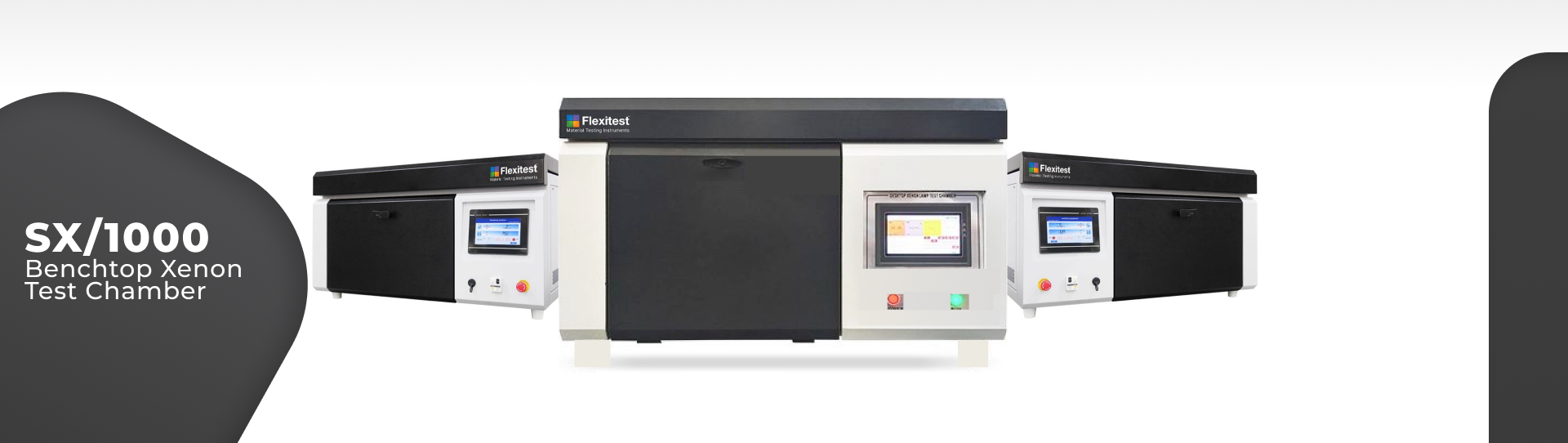
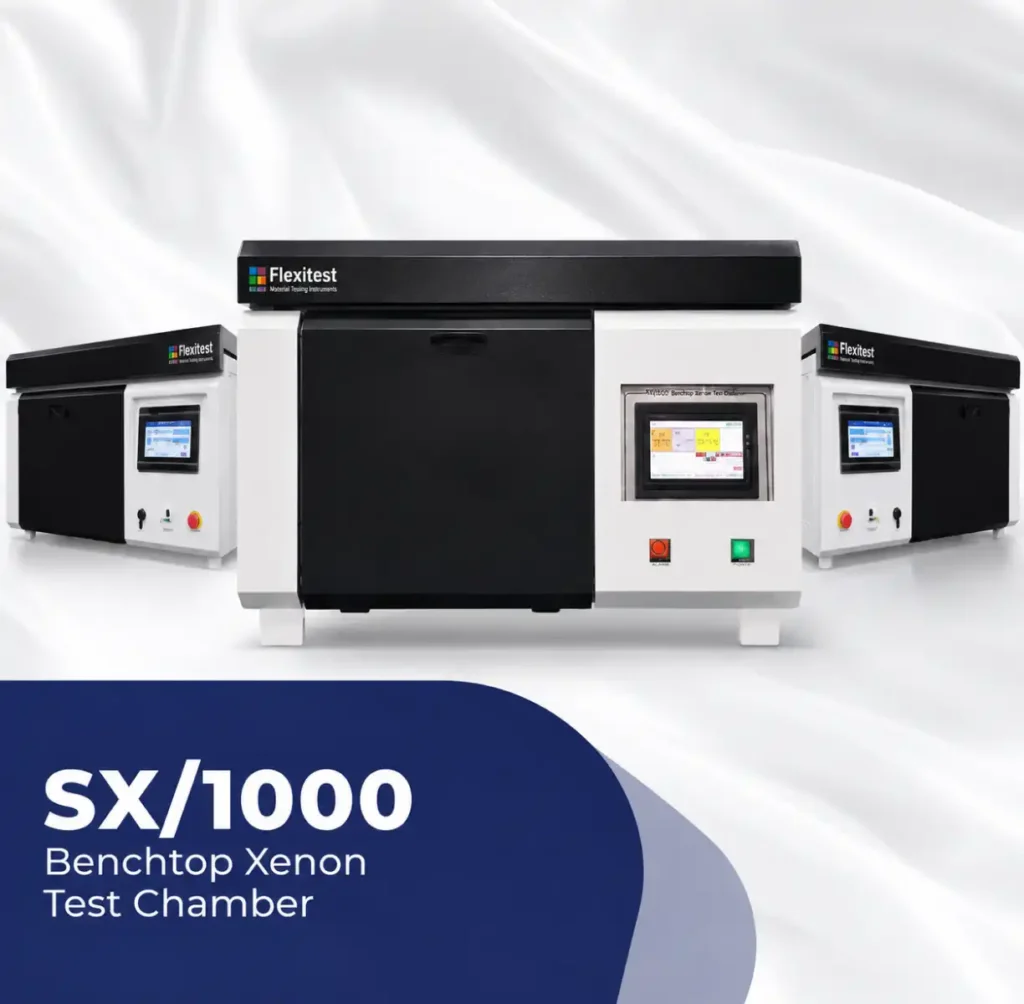

Xenon test chambers use xenon arc lamps to simulate the full spectrum of sunlight, including UV, visible light, and infrared (IR). These chambers replicate the complete solar radiation spectrum, providing a more comprehensive assessment of light-induced aging and weathering.
Submit Your Details to Download Brochure!
Features
- Standard Xenon Light Source
- Easy to Operate Touch Screen
- Irradiation Energy Automatic Control
- Various optical filters are available
- Humanized Design Sample Holder
❓ Frequently Asked Questions – Benchtop Xenon Test Chamber SX/1000
What is the Benchtop Xenon Test Chamber SX/1000 and how does it work for packaging testing?
The SX/1000 is a compact benchtop xenon arc lamp aging test chamber designed for accelerated weathering and photostability testing of packaging materials. Xenon test chambers use xenon arc lamps to simulate the full spectrum of sunlight including UV, visible light, and infrared radiation, replicating the complete solar radiation spectrum for comprehensive assessment of light-induced aging and weathering. The SX/1000 uses a 1.8 kW air-cooled xenon lamp with a 1000 cm² exposure area, holding 9 standard packaging samples simultaneously.
What is ASTM G155 and how does the SX/1000 comply with it for packaging material testing?
ASTM G155 is a popular international practice for accelerated weathering testing, guiding users and equipment manufacturers on the use and design of xenon arc lamp test chambers to simulate the damaging effects of full-spectrum sunlight on materials including basic principles and operating procedures to reproduce the same effects that materials see outdoors and behind window glass — sunlight, elevated temperatures, and moisture. The SX/1000 complies with ASTM G155 through its optical filter system, irradiance control, and blackboard temperature monitoring — all required parameters defined in the standard.
What is ISO 4892-2 and how does it apply to xenon arc testing of packaging plastics?
ISO 4892-2 specifies xenon arc lamp testing for plastics, simulating real-world conditions to assess material performance over time. It is applicable to plastics exposed to sunlight or artificial lighting including outdoor products and packaging. ISO 4892-2 is the international equivalent of ASTM G155 and is directly referenced within it. For packaging manufacturers exporting to European and global markets, ISO 4892-2 test reports are typically required alongside or instead of ASTM G155 for supplier qualification and material approval submissions.
What is the difference between a xenon arc chamber and a fluorescent UV chamber for packaging testing?
ASTM G155 references ISO 4892-2 for xenon arc testing while ASTM G154 is an alternative standard that uses fluorescent lamps with a different light source. Xenon arc chambers simulate the full solar spectrum including UV, visible, and infrared radiation, while fluorescent UV chambers simulate only the UV portion of sunlight. For packaging testing, xenon arc chambers like the SX/1000 provide more realistic simulation — essential when colour stability, print fade, and visible light degradation of packaging materials must be evaluated together with UV resistance.
What optical filters are available on the SX/1000 and which should be used for packaging testing?
The SX/1000 offers three optical filter types. The UV extended filter permits UV wavelengths below the natural cut-on of sunlight, providing accelerated severe stress testing for quick material screening. Daylight filters are used for materials exposed to direct outdoor sunlight while window glass filters simulate sunlight filtered through glass and are used for materials exposed to indoor environments such as retail display or office packaging near windows. For most flexible and rigid packaging applications, the daylight filter is the standard recommendation.
How is irradiance controlled and monitored on the SX/1000 xenon test chamber?
The SX/1000 provides automatic irradiance control monitored at 340 nm or 420 nm (narrowband) or 300–400 nm (broadband) — selectable before ordering. Narrowband 340 nm monitoring is the most widely used reference wavelength in ASTM G155 and ISO 4892-2 testing. The irradiance setting range is 0.3–0.8 W/m² at 340 nm. The touch screen interface allows operators to set irradiance, test time, and blackboard temperature independently, with all running parameters exportable via USB for test documentation and traceability.
What packaging materials can be tested in the SX/1000 Benchtop Xenon Test Chamber?
The SX/1000 tests a wide range of packaging materials including flexible films (BOPP, polyester, PE laminates), printed packaging and labels, rigid plastic containers and caps, pharmaceutical blister films, aluminium foil laminates, paper-based cartons and folding boxes, adhesive tapes, and UV-protective coatings on packaging. Testing is used to evaluate the stability of packaging materials under prolonged exposure to light and humidity, ensuring product safety and shelf life. Nine standard 150×70 mm samples fit in the 1000 cm² exposure area per test run.
How is the SX/1000 used for photostability testing of pharmaceutical packaging per ICH Q1B?
ICH Q1B is the globally accepted guideline mandating photostability testing for pharmaceutical products and their packaging. Testing determines whether light exposure results in unacceptable change and what protective packaging is required. Xenon arc lamps that simulate natural or glass-filtered sunlight are used as specified light sources. ICH Q1B requires a minimum exposure of 200 W·hr/m² UV and 1.2 Mlx·hr/m² visible light. The SX/1000 with daylight or window glass filter and irradiance control at 420 nm supports ICH Q1B photostability testing for pharmaceutical packaging qualification.
What material properties are evaluated on packaging samples after xenon arc weathering testing?
After xenon arc exposure per ASTM G155 and ISO 4892-2 on the SX/1000, the following packaging material properties are evaluated: colour change and fading (Delta E measurement), gloss retention, haze increase, tensile strength and elongation retention, print adhesion and ink fade, surface cracking or chalking, barrier property changes, and seal strength of laminates. After exposure to ASTM G155, various measurements can be taken to quantify the impact of aging including colour change, gloss loss, cracking, chalking, and fading.
How should the SX/1000 xenon lamp and chamber be maintained for accurate and repeatable test results?
The SX/1000 xenon lamp has a service life of approximately 1500 hours and must be replaced at the end of its rated life to maintain correct irradiance levels. Irradiance output must be verified regularly using the chamber’s automatic irradiance control system and cross-checked against ASTM G155 and ISO 4892-2 exposure requirements. Optical filters must be inspected for solarisation and replaced when transmission degrades. All calibration and lamp replacement records must be maintained per ISO 17025 laboratory competence requirements for traceability in test reports and regulatory submissions.
Which Xenon Aging Chambers is right For You?
Compare Sunrise xenon test chamber models by lamp configuration, irradiance control, exposure capacity, and available functions.
| Specification | SX/1000 Benchtop |
SX/1000/H Small |
SX/2800/H Standard |
SX/2200/H Standard |
SX/6500/H Large |
STX/1000/H Tilting |
SWTX/3600/H Walk-in |
|---|---|---|---|---|---|---|---|
| Lamp Configuration | |||||||
| Light tube | 1 × 1.8 kW Air-cooled xenon (USA / domestic) |
1 × 1.8 kW Air-cooled xenon (USA / domestic) |
3 × 1.8 kW Air-cooled xenon (USA) |
1 × 1.8 kW Air-cooled xenon (USA) |
1 × 6.5 kW Water-cooled xenon (USA) |
3 × 1.8 kW Air-cooled xenon |
6 × 1.8 kW Air-cooled xenon |
| Standard filter | UV Extension | UV Extension | Daylight | Daylight | Daylight | Daylight | Daylight |
| Exposure Capacity | |||||||
| Std sample holders (150 × 70 mm) |
9 | 9 | 25 | 22 | 65 | — | — |
| Programming cycle filter | 9 | UV Extension | UV Extension | UV Extension | UV Extension | — | — |
| Irradiance Control | |||||||
| Irradiance auto control | ✔ | ✔ | ✔ | ✔ | ✔ | ✔ | ✔ |
| Irradiance range @ 340 nm | 0.3 – 0.8 W/m² | 0.3 – 0.8 W/m² | 0.3 – 0.75 W/m² | 0.3 – 0.75 W/m² | 0.3 – 0.75 W/m² | 0.3 – 0.75 W/m² | 0.3 – 0.75 W/m² |
| Irradiance control points | 1 | 3 | 4 | 4 | 4 | Multiple | Multiple |
| Cumulative energy monitoring | ✔ | — | — | — | — | — | — |
| Temperature Control | |||||||
| BPT auto control | ✔ | ✔ | ✔ | ✔ | ✔ | ✔ | ✔ |
| Black panel temp (BPT) range | +30 – 90 °C | +30 – 90 °C | +20 – 90 °C | +30 – 100 °C | +20 – 110 °C | +20 – 110 °C | +20 – 110 °C |
| Humidity & Water | |||||||
| Chamber humidity auto control | ✔ | ✔ | — | — | — | — | — |
| Spray function | ✔ | Front of test panel | Front of test panel | Front of test panel | Front of test panel | — | — |
| Pure water system | Standard | Optional | Optional | Optional | Optional | Optional | Optional |
| Functions & Controls | |||||||
| Dark function | ✔ | — | — | — | — | — | — |
| Test data download | ✔ | ✔ | ✔ | ✔ | ✔ | ✔ | ✔ |
| Alarm function | ✔ | ✔ | ✔ | ✔ | ✔ | ✔ | ✔ |
| Calibration function | ✔ | ✔ | ✔ | ✔ | ✔ | ✔ | ✔ |
* ✔ Standard equipment · — Not available / Not applicable · BPT = Black Panel Temperature
✔ Standard · — Not available · BPT = Black Panel Temperature
Related Machines

UV Test Chambers simulate UV exposure, temperature & moisture cycles to evaluate polymer fading, degradation and weathering resistance.
View Details →
UV Test Chambers simulate UV, temperature & moisture exposure to evaluate fading, degradation & weathering of automotive materials.
View Details →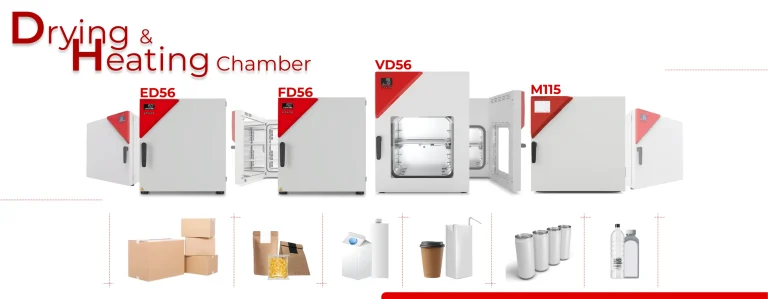
BINDER drying chambers deliver precise, energy-efficient heating with APT.line™, supporting ASTM E145, D618, D4332 & F1980.
View Details →
Fast, precise moisture analysis for solids, liquids & pastes with AURI heating and up to 100 programmable methods.
View Details →


