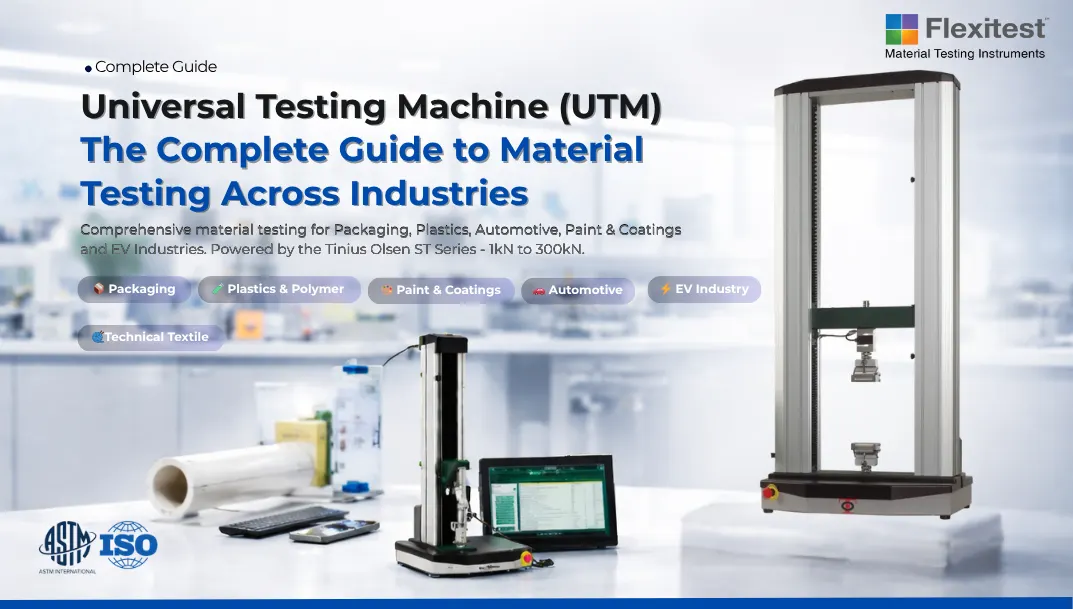
- Complete Technical Guide
How to Choose the Right Universal Testing Machine for Your Industry
Material testing for Packaging, Plastic & Polymer , Automotive, Paint & Coating, and EV Industries – powered by the Tinius Olsen ST Series
What Is a Universal Testing Machine (UTM)?
A Universal Testing Machine, commonly known as a UTM Machine, is an electromechanical or hydraulic system used to evaluate the mechanical properties of materials under controlled conditions. The term “universal” reflects the machine’s ability to perform multiple types of mechanical tests – tensile, compression, flexural, peel, tear, shear, and more – on virtually any material, from thin plastic films to reinforced composites and metals.
“UTM Machines are the backbone of quality control laboratories and R&D departments across industries – delivering precise, repeatable data to meet international standards and ensure product safety.”
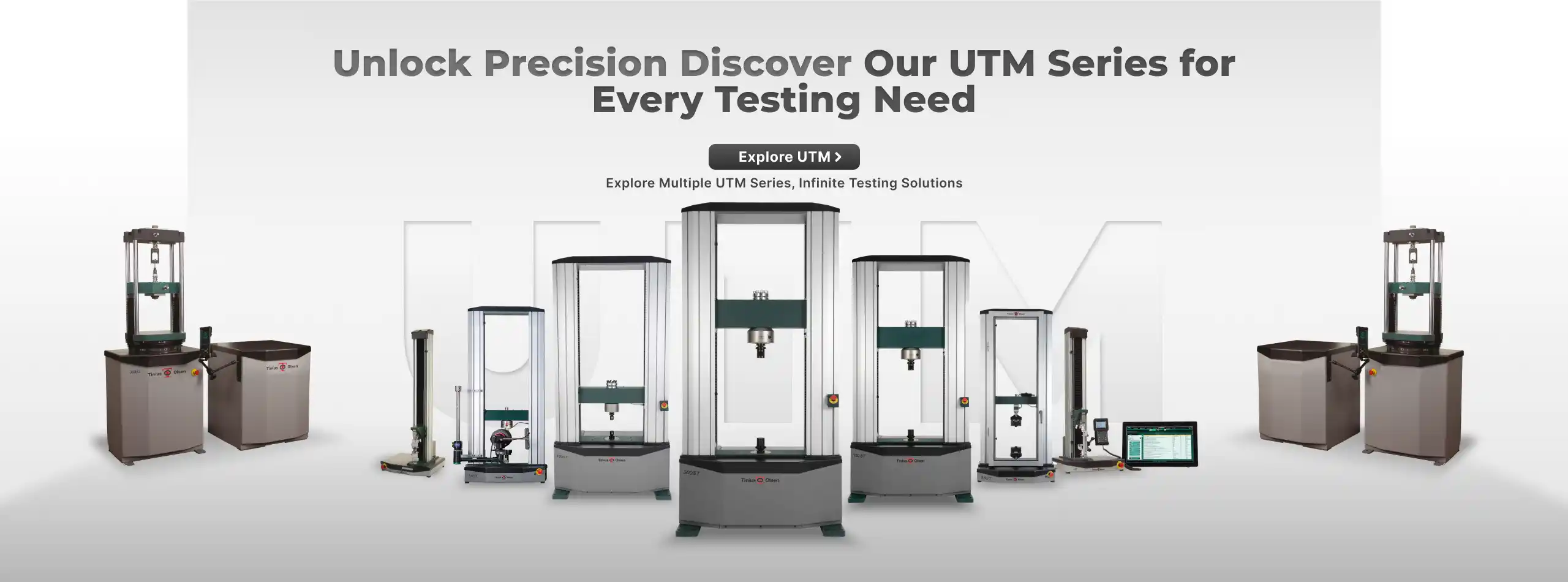
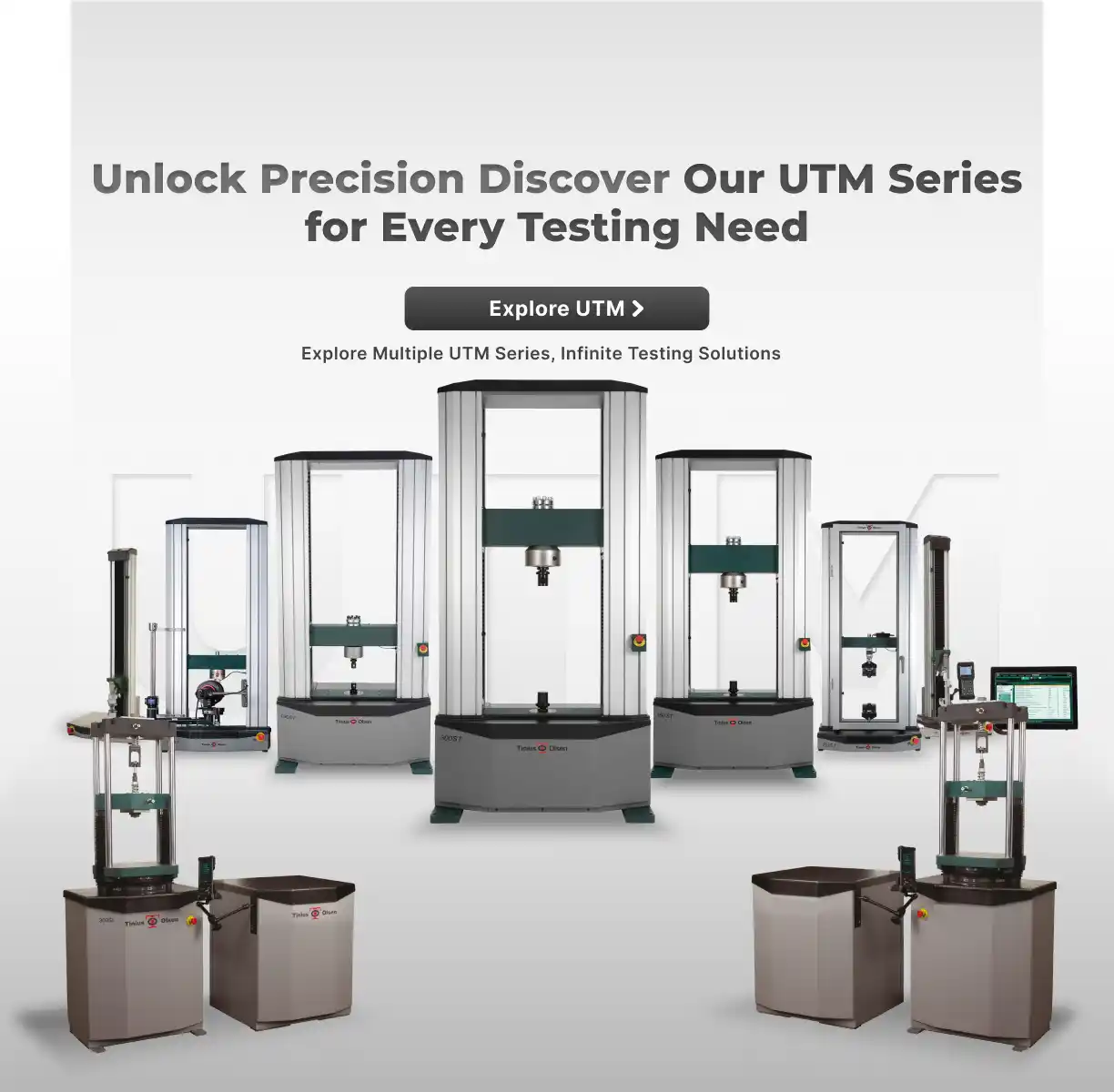
The Tinius Olsen ST Series of electromechanical universal testing systems is designed to test a wide range of materials – including plastics, films, paper, packaging materials, adhesives, foils, medical devices, composites, metals, and components – in tension, compression, flexure, shear, peel, and many more test modes.
Why Is Universal Testing Machine Essential Across Industries?
Every industry works with materials that must perform under stress – and a Universal Testing Machine (UTM Machine) is the one instrument that validates whether they actually will. In packaging, it checks if a sealed pouch will survive transit without tearing or a laminated film will hold its bond. In plastics and polymers, it confirms that an injection-moulded part or extruded pipe has consistent strength from batch to batch. In automotive, it verifies that chassis steel, seatbelt webbing, and dashboard plastics can handle the forces they’ll face on the road. In paint and coatings, it measures whether a coating will peel off, crack under bending, or lose adhesion over time. In the EV sector, it tests battery separator films, electrode coatings, and lightweight body panels to ensure passenger safety. In technical textiles, it validates that high-performance fabrics used in aerospace, defence, and medical applications can withstand extreme tensile and tear forces. Across all these sectors, the UTM delivers one thing every manufacturer needs – precise, repeatable, standards-compliant data that proves a material is safe and fit for purpose before it reaches the end user.
How Does a Universal Testing Machine Work?
A UTM works by applying a controlled force to a test specimen and measuring the material’s response. The core components include:
Load Frame
The rigid structure that houses the testing mechanism and provides stability during high-force tests.
Crosshead
The moving part that applies force to the specimen at a precisely controlled speed and displacement.
Load Cell
A high-precision transducer that measures the applied force with accuracy better than 0.2% of the reading.
Grips & Fixtures
Pneumatic, manual, or wedge-action grips that securely hold the specimen without slippage.
Extensometer
Contact or non-contact devices that measure specimen strain and elongation with exceptional precision.
Software
Horizon Materials Testing Software — data acquisition, analysis, and standards-compliant reporting.
The ST Series from Tinius Olsen features an internal data rate of up to 2,730 samples per second per channel, self-identifying load cells, built-in pneumatic supply for grip operation, T-slot columns for flexible accessory mounting, and the powerful Horizon Materials Testing Software for comprehensive data analysis and multi-machine control.
Technical Specifications of a UTM: What You Need to Know
While the versatility of a Universal Testing Machine is its greatest strength, its performance is defined by its technical parameters. The specifications of a UTM vary significantly based on the frame type (single-column vs. dual-column) and the material being tested.
If you are looking to invest in a UTM, these are the five core specifications you must evaluate:
1. Load Capacity (Force Range)
The load capacity determines the maximum force the machine can exert.
Range: Standard UTMs range from 5 kN (500 kgf) for lightweight materials like plastic films and textiles, up to 2000 kN (200 Tonnes) or more for heavy-duty metals and construction materials.
Selection Tip: To ensure high-resolution data and machine longevity, your average test load should ideally fall between 20% and 80% of the machine’s total capacity.
2. Crosshead Speed Range
Standardized testing (such as ASTM D882 for films or ISO 527 for plastics) often requires specific strain rates to get accurate results.
Typical Spec: Most modern UTMs offer a variable speed range from 1 mm/min to 1000 mm/min.
Why it matters: Precise speed control ensures consistent loading rates, which is vital for calculating the Modulus of Elasticity and Yield Strength accurately.
3. Measurement Accuracy
In quality control, the margin for error is slim.
Industry Standard: Most high-precision UTMs provide an accuracy of ±0.5% to ±1% of the applied load.
Flexitest Advantage: Our machines are engineered to provide NABL-traceable accuracy, ensuring your results are internationally recognized and audit-ready.
4. Control & Automation Systems
The “brain” of the UTM defines the user experience and data reliability.
Manual/Digital: Suitable for simple pass/fail tests and basic peak-load measurements.
Computer-Controlled (Advanced): This is the modern industry standard. It allows for real-time stress-strain curve plotting, automatic data logging, and comprehensive report generation complying with global ISO/ASTM protocols.
5. Power Supply & Infrastructure
Depending on the motor type (Servo vs. Induction) and the load capacity, the power requirements change.
Standard Lab Models: Usually operate on a single-phase 220V/50Hz supply.
Heavy-Duty Industrial Models: These often require a three-phase 440V/60Hz connection to power the high-torque motors or hydraulic pumps required for metal testing.
Types of Tests Performed on a UTM
Tensile Testing
Measures resistance to being pulled apart. Determines tensile strength, yield strength, elongation, and Young's modulus.
Compression Testing
Evaluates behaviour under crushing force. Essential for rigid plastics, packaging containers, and EV battery enclosures.
Flexural Testing
Determines resistance to cracking under bending stress using 3-point or 4-point methods.
Peel & Adhesion
Measures bond strength between laminates, coatings, labels, and sealed packaging at 90° or 180° angles.
Tear Testing
Evaluates force required to propagate a tear through films, textiles, rubber, and flexible packaging.
Shear Testing
Measures resistance to sliding forces. Important for adhesives, fasteners, and composite interlaminar testing.
A Universal Testing Machine can perform a wide variety of mechanical tests. The most common ones relevant to industrial quality control include:
UTM Machine Applications by Industry
1. UTM for Packaging Industry
The packaging sector relies heavily on UTMs for quality control of flexible and rigid packaging materials. From verifying heat-seal integrity on food pouches to testing the compressive strength of shipping containers, a UTM is indispensable in any packaging QC lab.
Recommended Models: 1ST (1kN), 5ST (5kN), 10ST (10kN), 25ST (25kN), C610H
Key ASTM & ISO Standards for Packaging
Flexitest India · Tinius Olsen ST Series · Packaging Testing
| ASTM | ISO | Test Name | Application |
|---|---|---|---|
| ASTM F88 Seal |
ISO 11607 | Seal Strength | Heat-sealed pouches, medical packaging, food sachets |
| ASTM D882 Tensile |
ISO 527-3 | Film Tensile | Tensile strength & elongation of plastic films (<1mm) |
| ASTM D1894 COF |
ISO 8295 | Coefficient of Friction | Static & kinetic COF for packaging line runnability |
| ASTM F904 Peel |
ISO 8510-1 | Bond / Peel Strength | Ply adhesion of laminates (film, foil, paper) |
| ASTM D828 Paper |
ISO 1924 | Paper Tensile | Tensile properties of paper & paperboard packaging |
| ASTM D903 Adhesive |
ISO 8510-2 | Adhesive Peel | 180° peel strength of labels, tapes, and adhesives |
| ASTM D642 Compression |
ISO 12048 | Compression | Compressive resistance of containers, caps, closures |
Submit Your Details to Download Brochure!
Type your paragraph here
2. UTM for Plastics & Polymer Industry
Plastics and polymer testing is the largest application segment for UTMs globally. From injection-moulded components to extruded profiles and thin films, every plastic product requires mechanical property validation before it reaches the market.
Recommended Models: 5ST (5kN), 10ST (10kN), 25ST (25kN)
Key ASTM & ISO Standards for Plastics & Polymers
Flexitest India · Tinius Olsen ST Series · Plastics & Polymer Testing
| ASTM | ISO | Test Name | Application |
|---|---|---|---|
| ASTM D638 Tensile |
ISO 527-1/2 | Plastic Tensile | Tensile strength of rigid & semi-rigid plastics (dumbbell specimens) |
| ASTM D882 Film |
ISO 527-3 | Film Tensile | Tensile properties of thin plastic films & sheeting |
| ASTM D790 Flexural |
ISO 178 | Flexural Test | 3-point bending strength of plastics & composites |
| ASTM D695 Compression |
ISO 604 | Compression | Compressive strength of rigid plastics |
| ASTM D412 Rubber |
ISO 37 | Rubber Tensile | Tensile strength of elastomers & rubber compounds |
| ASTM D624 Tear |
ISO 34-1 | Tear Strength | Tear resistance of rubber & elastomers |
| ASTM D1894 COF |
ISO 8295 | Coefficient of Friction | Coefficient of friction of plastic films |
Submit Your Details to Download Brochure!
3. UTM for Automotive Industry
The automotive sector demands rigorous material testing machine across metals, plastics, composites, rubber, adhesives, and coatings. From dashboard plastics to structural steel, seatbelts to under-the-hood rubber hoses, UTMs validate every component that goes into a vehicle.
Recommended Models: 25ST (25kN), 50ST (50kN), 100ST (100kN), 150ST (150kN), 300ST (300kN)
Key ASTM & ISO Standards for Automotive
Flexitest India · Tinius Olsen ST Series · Automotive Testing
| ASTM | ISO | Test Name | Application |
|---|---|---|---|
| ASTM E8 Metal |
ISO 6892-1 | Metal Tensile | Tensile strength of steel, aluminium, and alloy components |
| ASTM D638 Plastic |
ISO 527-1/2 | Plastic Tensile | Dashboard, bumper, and interior plastic components |
| ASTM D790 Flexural |
ISO 178 | Flexural Test | Bending strength of structural polymer parts |
| ASTM A370 Steel |
— | Steel Mechanical | Mechanical properties of steel (tension, bend, hardness) |
| ASTM D412 Rubber |
ISO 37 | Rubber Tensile | Rubber seals, gaskets, hoses, and weather strips |
| ASTM D3039 Composite |
ISO 527-4 | Composite Tensile | Carbon/glass fibre-reinforced structural composites |
| ASTM D6775 Webbing |
— | Webbing Tensile | Seatbelts, harnesses, safety restraint systems |
Submit Your Details to Download Brochure!
4. UTM for Paint & Coating Industry
Coating and paint manufacturers use UTMs to evaluate adhesion strength, flexibility, tensile properties of free films, and peel resistance of coated substrates. These tests are critical for automotive paints, industrial coatings, powder coatings, and protective films.
Recommended Models: 10ST (10kN), 50ST (50kN), 100ST (100kN) , 300ST (300kN)
Key ASTM & ISO Standards for Paint & Coatings
Flexitest India · Tinius Olsen ST Series · Paint & Coating Testing
| ASTM | ISO | Test Name | Application |
|---|---|---|---|
| ASTM D4541 Pull-Off |
ISO 4624 | Pull-Off Adhesion | Adhesion strength of coatings using portable pull-off testers |
| ASTM D903 Peel |
ISO 8510-2 | Peel Strength | 180° peel adhesion of coatings, films, and laminates |
| ASTM D882 Film |
ISO 527-3 | Free Film Tensile | Tensile properties of coating free films & paint films |
| ASTM D2370 Elongation |
— | Elongation of Coatings | Tensile elongation of applied organic coatings |
| ASTM D3359 Tape |
— | Tape Adhesion Test | Cross-hatch adhesion test for coatings on substrates |
| ASTM D522 Bend |
ISO 1519 | Mandrel Bend | Flexibility & crack resistance of coatings on metal panels |
| ASTM D2794 Impact |
ISO 6272 | Impact Resistance | Rapid deformation (impact) resistance of organic coatings |
Submit Your Details to Download Brochure!
The rapidly growing EV sector introduces unique material testing challenges. From battery cell components to lightweight structural materials, every element must be tested for safety, durability, and regulatory compliance. UTMs play a critical role in EV battery manufacturing, lightweight material development, and component validation.
Recommended Models: 10ST (10kN)
Key ASTM & ISO Standards for EV Industry
Flexitest India · Tinius Olsen ST Series · Electric Vehicle Testing
| ASTM | ISO | Test Name | Application |
|---|---|---|---|
| ASTM D882 Separator |
ISO 527-3 | Separator Film Tensile | Tensile strength of battery separator films |
| ASTM D1894 COF |
ISO 8295 | Separator COF | Friction of separator films for winding quality control |
| ASTM D903 Electrode |
ISO 8510-2 | Electrode Peel | Peel adhesion of electrode coatings on current collectors |
| ASTM E8 Metal |
ISO 6892-1 | Metal Tensile | Aluminium/copper foil and busbar tensile properties |
| ASTM D638 Plastic |
ISO 527-1/2 | Plastic Tensile | Battery enclosure and housing polymer components |
| ASTM D3039 Composite |
ISO 527-4 | Composite Tensile | Lightweight CFRP/GFRP structural body panels |
| ASTM D695 Compression |
ISO 604 | Cell Compression | Compressive strength of battery cell enclosures & spacers |
Submit Your Details to Download Brochure!
Every industry works with materials that must perform under stress – and a Universal Testing Machine (UTM Machine) is the one instrument that validates whether they actually will. In packaging, it checks if a sealed pouch will survive transit without tearing or a laminated film will hold its bond. In plastics and polymers, it confirms that an injection-moulded part or extruded pipe has consistent strength from batch to batch. In automotive, it verifies that chassis steel, seatbelt webbing, and dashboard plastics can handle the forces they’ll face on the road. In paint and coatings, it measures whether a coating will peel off, crack under bending, or lose adhesion over time. In the EV sector, it tests battery separator films, electrode coatings, and lightweight body panels to ensure passenger safety. In technical textiles, it validates that high-performance fabrics used in aerospace, defence, and medical applications can withstand extreme tensile and tear forces. Across all these sectors, the UTM delivers one thing every manufacturer needs – precise, repeatable, standards-compliant data that proves a material is safe and fit for purpose before it reaches the end user.
Key ASTM & ISO Standards for Technical Textiles
Flexitest India · Tinius Olsen ST Series · Technical Textile Testing
| ASTM | ISO | Test Name | Application |
|---|---|---|---|
| ASTM D5034 Grab |
ISO 13934-1 | Grab Tensile Strength | Tensile strength and elongation of woven and nonwoven fabrics |
| ASTM D5035 Strip |
ISO 13934-2 | Strip Tensile Strength | Strip tensile strength of woven fabrics, geotextiles & technical textiles |
| ASTM D5587 Tear |
ISO 13937-1 | Tear Strength (Trapezoidal) | Trapezoidal tear strength of woven fabrics, nonwovens & coated textiles |
| ASTM D1682 Breaking |
ISO 13934-1 | Breaking Strength | Breaking strength and elongation of woven textile fabrics |
| ASTM D6775 Webbing |
— | Webbing Tensile Strength | Tensile strength of webbing — seatbelts, harnesses & safety restraints |
| ASTM D4595 Geo |
ISO 10319 | Geotextile Wide-Width Tensile | Wide-width tensile properties of geotextiles used in civil engineering |
| ASTM D4884 Seam |
ISO 10321 | Seam Strength | Seam / joint strength of sewn geotextiles and industrial textiles |
| ASTM D2256 Yarn |
ISO 2062 | Yarn Tensile Strength | Breaking force and elongation of single yarn from a package or fabric |
Submit Your Details to Download Brochure!
If you are setting up a new QC laboratory, upgrading your existing material testing capabilities, or simply need guidance on which UTM model and accessories fit your specific testing requirements, the Flexitest team is here to help. Reach out to us at sales@flexitest.in or call +91 93263 25135 for expert consultation, live product demonstrations, and end-to-end support – from machine selection and installation to training, calibration, and annual maintenance.
Recent Post

Weathering Chamber Quotation Checklist for Automotive Labs

Automotive Weathering Testing: Xenon vs UV Explained