
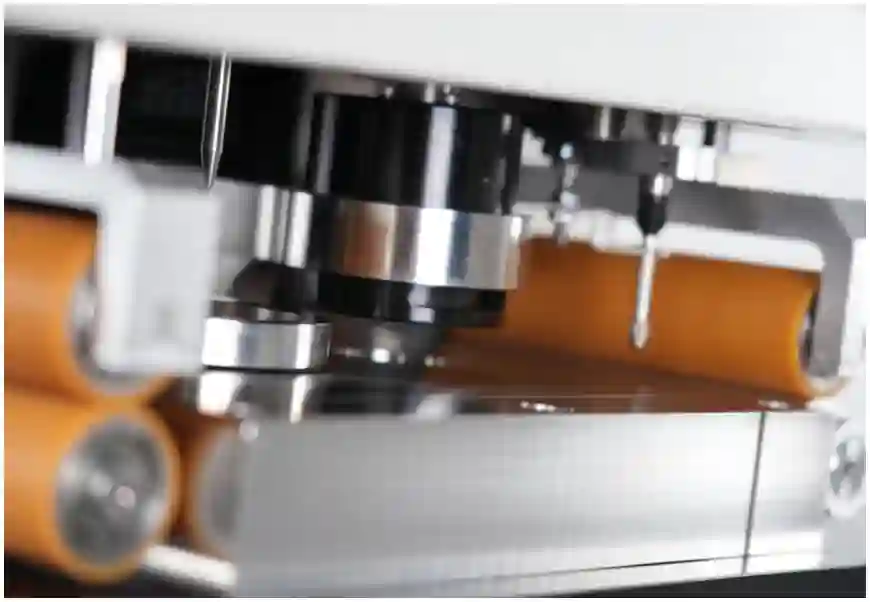
An air permeability tester measures how easily air passes through a fabric. It sounds simple, yet this one number decides whether an airbag inflates correctly, a filter traps dust, or a sportswear fabric feels cool on the skin.
In this guide we start from the very basics. You will learn what air permeability means, why technical textile makers care about it, how it is tested, and what to look for in a tester. Then we look closely at the FX 3300 LabAir IV from Textest Instruments, available in India through Flexitest.
What is air permeability?
Air permeability is the rate at which air flows through a material when there is a small difference in air pressure between its two sides.
Think of blowing through a handkerchief and then through a raincoat. Air rushes through the handkerchief but hardly moves through the raincoat. The handkerchief has high air permeability; the raincoat has low air permeability.
A fabric is made of yarns and fibres with tiny gaps between them. The size, number and shape of these gaps decide how much air gets through. Things that change the gaps include:
- Weave or knit structure: a tight plain weave lets less air through than an open knit.
- Yarn and fibre type: fine, tightly twisted yarns pack closer together.
- Fabric thickness and density (GSM): heavier, denser fabrics usually block more air.
- Finishes and coatings: calendering, lamination or coatings can close the gaps almost completely.
Because our eyes cannot measure these tiny gaps, laboratories use an air permeability tester to put an exact number on them.
Why air permeability matters in technical textiles
Technical textiles are fabrics made for performance rather than looks. In these products, air permeability is often a safety or quality requirement, not a nice-to-have. Here is where it shows up:
| Application | Why air permeability matters |
|---|---|
| Automotive airbags | The fabric must hold gas long enough to cushion the passenger, then release it in a controlled way. |
| Filtration media (air, dust, HVAC) | Air must pass freely while particles are trapped. Too low means high energy use; too high means poor filtering. |
| Nonwovens (medical, hygiene, geotextiles) | Breathability of masks, gowns and diapers depends on it. |
| Sportswear and protective clothing | Controls breathability and comfort, or wind resistance in outerwear. |
| Parachutes and sailcloth | Decides how the canopy or sail fills and holds its shape. |
| Paper and packaging | Porosity affects printing, filtering and packaging performance. |
| Foams (seating, bedding) | Air flow affects comfort and heat build-up. |
For manufacturers, testing air permeability helps to:
- Check incoming raw material against the supplier's specification.
- Keep production consistent from batch to batch.
- Meet buyer and export requirements that quote ASTM, ISO or JIS standards.
- Develop new products, such as a lighter fabric with the same wind resistance.
India's technical textile sector is growing fast, and export buyers increasingly ask for test reports to international standards. A reliable in-house tester saves time and outside lab fees.
How is air permeability tested?
Every air permeability tester follows the same basic idea: hold the fabric firmly, pull air through it at a fixed pressure difference, and measure how much air flows.
- Clamp the sample. A piece of fabric is clamped over a round opening of known area, called the test surface (for example 20 cm²).
- Create a pressure difference. A vacuum pump draws air through the fabric until the pressure drop across it reaches the value the standard asks for. For many fabric standards this is 100 Pa or 125 Pa.
- Measure the air flow. The instrument measures the volume of air passing through each second.
- Calculate the result. Air flow is divided by the test area, giving air permeability as a velocity.
In simple terms: air permeability = volume of air flowing per second ÷ test area.
Testing several spots on the same fabric and averaging them gives a more reliable result, because fabrics are rarely perfectly even.
Common units, and how they convert
Different countries and industries use different units, which often confuses new users. The good news is that they all describe the same thing.
| Unit | Where it is common | 1 mm/s equals |
|---|---|---|
| mm/s | ISO and European standards | 1 |
| l/m²/s | Same as mm/s, used interchangeably | 1 |
| cm³/cm²/s | ASTM D737, older lab reports | 0.1 |
| ft³/ft²/min (CFM) | US buyers, airbag and filter industry | 0.197 |
| l/dm²/min | Some European and paper standards | 0.6 |
| m³/m²/min | Filtration and industrial fabrics | 0.06 |
| m³/m²/h | HVAC and building materials | 3.6 |
A good tester displays the result in whichever unit your customer asks for, so no manual conversion is needed.
Meet the FX 3300 LabAir IV air permeability tester
The FX 3300 LabAir IV is the fourth generation of Textest's well-known FX 3300 series. It brings 50 years of experience and R&D into one instrument for measuring both air permeability and pressure drop. It stands out for being easy to use, flexible, and able to handle a very wide measuring range, from dense coated fabrics to open nonwovens.
Key features in plain language
- Sophisticated design: a compact test head and touchscreen unit mounted on a mobile trolley, so it fits neatly into a QC lab.
- More than air permeability: it also measures pressure drop, useful for filter media and other flow-resistance testing.
- Sequence Module: lets operators run a series of tests in a set order, which speeds up routine QC.
- Automatic cleaning function: uses compressed air to keep the instrument clean. Compressed air is optional; the tester works without it.
- Automatic measuring range selection: the instrument picks the right range by itself, so the operator does not need to guess the fabric's permeability in advance.
- Evaluation and printing options: results can be evaluated on the instrument and printed for reports and customer certificates.
Technical specifications
| Parameter | FX 3300 LabAir IV |
|---|---|
| Measuring range (air permeability) | 0.4 to 750 cm³/cm²/s at 5 cm²; 1 to 10,000 mm/s (l/m²/s) at 20 cm² |
| Units | mm/s, l/m²/s, l/dm²/min, ft³/ft²/min, cm³/cm²/s, m³/m²/min, m³/m²/h |
| Measurement accuracy | Better than ±3% of displayed value |
| Test pressure | 20 to 2,500 Pa (can be increased to 5,000 Pa) |
| Test surfaces | 5, 20, 25, 38 and 100 cm² (others on request) |
| User interface | Touchscreen |
| Power supply | 195 to 260 VAC, 50/60 Hz, max. 1,100 W; or 85 to 130 VAC, 50/60 Hz, max. 1,100 W |
| Compressed air | 5 to 8 bar, only needed for the cleaning function |
What these numbers mean for you
- Wide range: from 1 to 10,000 mm/s covers almost everything from airbag fabric to highly open nonwovens on one machine.
- Five test areas: choose a small head for narrow samples or a large 100 cm² head for uneven fabrics like nonwovens, where a bigger area gives a more representative result.
- Flexible pressure: 20 to 2,500 Pa (up to 5,000 Pa) means you can follow different standards without changing instruments.
- ±3% accuracy: consistent results that hold up in buyer audits and supplier disputes.
Test standards the LabAir IV complies with
A test standard is an agreed recipe for doing a test, so results from different labs can be compared. The FX 3300 LabAir IV complies with the standards below and many other national and international methods.
| Standard | Region / body | Typical material |
|---|---|---|
| ASTM D737 | USA | Textile fabrics |
| ASTM D3574 | USA | Flexible foams |
| DIN 53887 | Germany | Textile fabrics |
| EN ISO 9237 | International / Europe | Textile fabrics |
| EN ISO 7231 | International / Europe | Flexible cellular polymers (foams) |
| GB/T 5453 | China | Textile fabrics |
| GB/T 24218.15 | China | Nonwovens |
| JIS L 1096-A | Japan | Woven and knitted fabrics |
| TAPPI T-251 | Paper industry | Porous paper and fabrics |
| WSP 70.1 | Nonwovens industry (EDANA / INDA) | Nonwovens |
If you export to the US, buyers will usually quote ASTM D737. European buyers typically ask for ISO 9237. Having one instrument that covers both saves you from maintaining two setups.
How to choose an air permeability tester: a quick checklist
Before buying any air permeability tester, check these points against your needs:
- Does it cover the standards your buyers ask for?
- Is the measuring range wide enough for all your fabrics, from dense to open?
- Does it offer several test areas for different sample sizes?
- Can it display results in the units your customers use?
- Is it easy for operators to use, ideally with automatic range selection?
- Is local service, calibration and training available?
The LabAir IV ticks the instrument-side boxes on this list. For the last point, buying through a local partner matters. You can see the full range on our air permeability testers page.
Why buy through Flexitest?
Flexitest supplies material testing instruments to Indian industry from its branch offices located across India. When you buy the FX 3300 LabAir IV through Flexitest, you get:
- Help choosing the right test heads and accessories for your products
- Installation and operator training at your site
- Local support for service and calibration questions
- One point of contact in India, so there are no time-zone or language gaps
Frequently asked questions
What does an air permeability tester measure?
It measures how much air passes through a fabric or sheet material per unit area, at a fixed pressure difference. The FX 3300 LabAir IV also measures pressure drop.
Which standard should I use for fabric air permeability testing?
Use the standard your buyer specifies. ASTM D737 is common for US buyers and EN ISO 9237 for European buyers. Nonwovens often follow WSP 70.1.
What is a good air permeability value for fabric?
There is no single good value. An airbag fabric needs very low permeability, while a sportswear mesh or filter needs high permeability. The right value comes from your product specification.
Can the LabAir IV test nonwovens, paper and foam?
Yes. It covers standards for nonwovens (WSP 70.1, GB/T 24218.15), paper (TAPPI T-251) and foams (ASTM D3574, EN ISO 7231), besides woven and knitted fabrics.
Does the FX 3300 LabAir IV need compressed air?
No. Compressed air at 5 to 8 bar is needed only for the automatic cleaning function. The instrument can be operated without it.
How accurate is the LabAir IV?
Measurement accuracy is better than ±3% of the displayed value.
What is the price of an air permeability tester in India?
Price depends on the test heads, accessories and configuration you need. Contact Flexitest for a quotation matched to your application.
Conclusion
Air permeability is one of the most important properties of technical textiles, affecting safety, filtration, comfort and export compliance. The FX 3300 LabAir IV air permeability tester combines a wide measuring range, ±3% accuracy, five test areas and compliance with ASTM, ISO, JIS, GB/T, TAPPI and WSP standards in one easy-to-use instrument.
Get a quote or a demo today
Tell us your fabrics and the standards your buyers ask for, and our team will match a configuration to them.
Or call +91 93263 25135 · sales@flexitest.in
