The notified commencement date of 6 October 2026 has now arrived for three woven-sack Quality Control Orders. The Gazette amendments dated 5 January 2026 set that date for the categories below, making this a timely point to review your laboratory's methods and equipment.
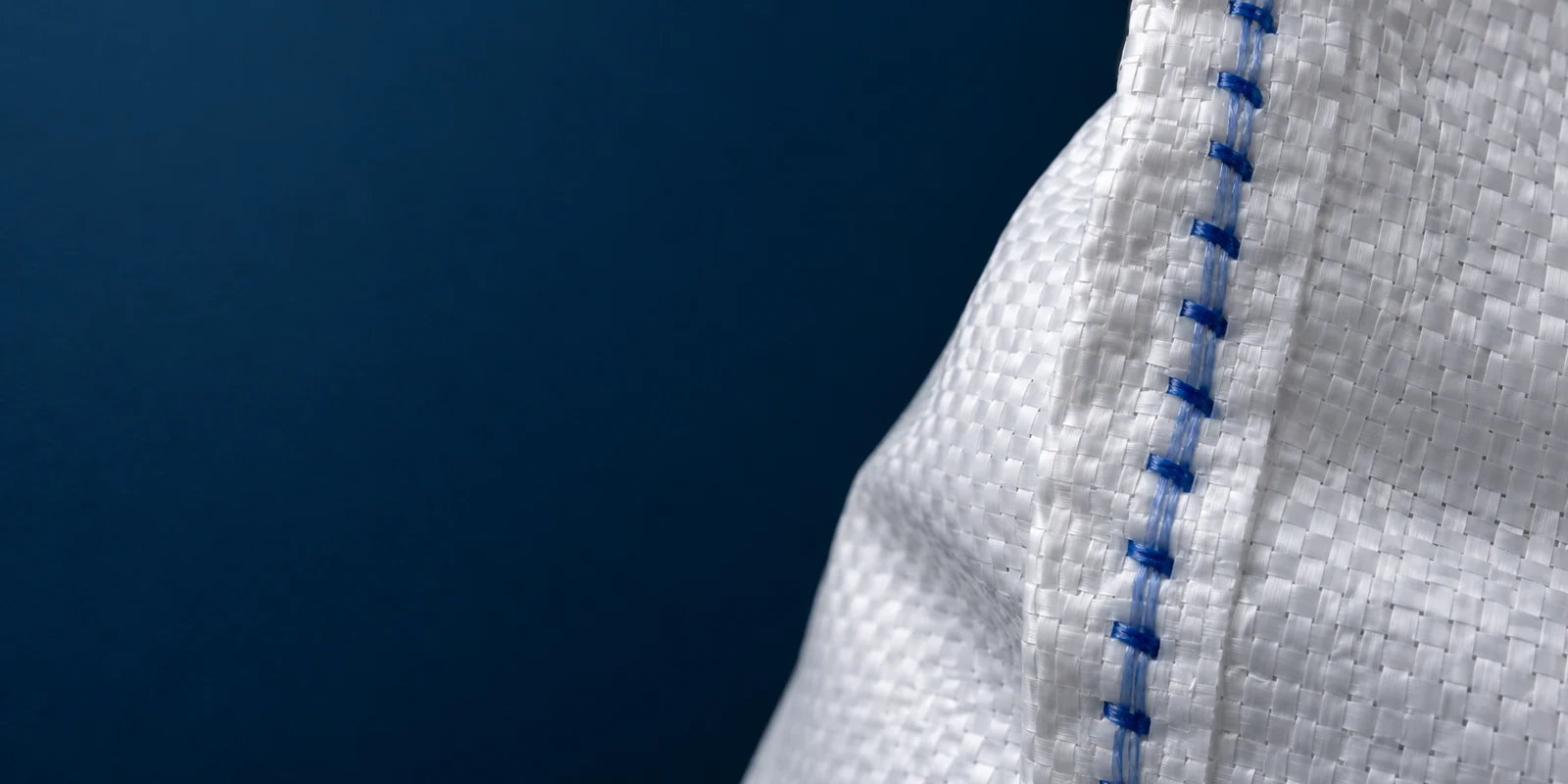
A woven sack can look right—and still fail where it matters.
For HDPE (high-density polyethylene) and PP (polypropylene) woven sacks, tensile testing helps assess fabric breaking strength, elongation at break and, where required by the method, seam or closure strength.
Its fabric may perform well while a seam becomes the weak point. Another batch may withstand a similar force but stretch differently before failure. For a quality team, these differences are a reason to look beyond appearance and understand the specimen.
Which BIS standard applies to your woven sacks?
This guide focuses on the three sack categories covered by the January 2026 amendment notice linked above. The table is not a complete list of standards for all woven sacks.
Woven-sack categories and their corresponding Indian standards
Indian standard
Product category
IS 11652:2017
HDPE/PP woven sacks for packaging of 50 kg cement
IS 16709:2017
PP woven, laminated, block bottom valve sacks for packaging of 50 kg cement
IS 17399:2020
PP/HDPE laminated woven sacks for mail sorting, storage, transport and distribution
The original orders require covered goods to conform to the corresponding Indian standard and bear the Standard Mark under a BIS Scheme-I licence; goods meant for export are excluded. Check the current order and amendments for your product's applicability.
The construction and intended use of the sack determine the relevant standard. Stitched cement sacks, block-bottom valve sacks and mail-handling sacks require their own assessment. Establish applicability from the current standard, its amendments and the relevant certification provisions before setting up a test programme.
Read the specimen
Fabric strength, elongation and seam testing
For HDPE/PP cement sacks covered by BIS IS 11652, the BIS product manual references IS 1969 (Part 1) for fabric breaking strength and elongation, and IS 9030 for seam strength. Where customers specify ASTM testing, ASTM D5035 covers strip tests, ASTM D5034 covers grab tests, and ASTM D1683/D1683M covers sewn seams in woven fabrics.
ASTM D5035 and D5034 are not recommended for fabrics with elongation above 11%. Confirm specimen behaviour and the specified method before selecting the load cell, grips and settings. ASTM methods are not interchangeable routes to BIS compliance; sewn-seam methods do not cover every valve or closure. Use the current applicable standards and amendments.
01
Fabric breaking strength
A tensile test measures the force a prepared fabric specimen withstands during loading. Test the prescribed directions separately to examine performance across the woven structure. Results linked to the batch, direction and method make production changes easier to identify and investigate.
02
Elongation at break
Breaking force describes only part of the response. Elongation shows how much the specimen extends before failure. Two specimens can withstand similar maximum forces while extending differently; recording both gives the quality team a fuller basis for comparison.
03
Seam and closure strength
A fabric test cannot establish the strength of a stitched seam or welded joint. If fabric results remain stable while seam results fall, investigate the closure process, specimen preparation and observed failure location. Assess the closure using the applicable method rather than assuming that fabric strength represents the finished sack.
Illustrative specimen schematics; follow the applicable preparation and test method.
Is a 1 kN tensile tester enough for woven-sack testing?
Understand the force range
A minimum requirement is a starting point.
It does not tell you the strongest specimen you will need to measure.
900 NListing minimum average*
1,000 N1 kN system capacity
1,150 NIllustrative specimen break
0 NCommon scale · 1,250 N
*900 N is the scoped BIS laboratory-listing example described below. The 1,150 N specimen is hypothetical; neither is a universal selection rule.
A BIS laboratory scope listing for IS 11652:2017 gives an example of 900 N minimum average fabric breaking strength in both directions, using the ravelled-strip method with reference to IS 1969 (Part 1). The current amended standard controls the acceptance requirement and test parameters.
Minimum breaking-strength requirements do not establish the maximum force of actual specimens. Select the complete test system for the expected range of actual breaking forces, including stronger production samples and an appropriate operating margin.
The sack's 50 kg filling capacity also does not determine the required load cell. The tensile tester evaluates a prescribed specimen. Use representative test records, supplier data or preliminary testing to establish the force envelope.
Build a dependable method
Grips, specimens and load cells: four setup decisions
01
Grips suited to the specimen
For flat woven fabric and prepared seam specimens, begin with the method's clamping requirements. Tinius Olsen lists the HT45 pneumatic grip for flat, flexible textiles; suitability still depends on specimen dimensions, force and the test method.
Grip width, contact surface, clamping pressure and alignment influence how securely a specimen is held. Slippage or premature damage near the jaws can compromise a result. Review the failure location and the method's validity rules before treating an unusual reading as a material defect.
02
Consistent specimen preparation
Dimensions, cutting direction and seam placement must follow the applicable method. Preserve sample identification so every result can be traced to its batch and orientation. Consistency is essential when comparing operators, shifts or laboratories.
03
Controlled test conditions
Define conditioning, initial grip separation and test speed in the procedure. Results obtained under different conditions may not be directly comparable. Saved software methods support consistent settings alongside operator training and routine checks. Confirm the required speed at the intended force and allow adequate travel for the grips, gauge length and expected extension.
04
The appropriate load cell
Frame capacity and load-cell measurement range are separate decisions. A higher-capacity frame can use different load cells. Select a load cell that measures expected forces within its verified working range, and check the ratings of all grips, adapters and fixtures. Published force accuracy does not replace calibration evidence for the supplied load cell.
Tinius Olsen 5ST and 25ST: specification comparison
These standard-height models offer different frame capacities. Match the selected load cell, grips, travel and software to the woven-sack application; confirm exactly what the quotation includes.
Published OEM specifications for standard 5ST and 25ST models
Specification
Tinius Olsen 5ST
Tinius Olsen 25ST
Frame capacity
5 kN
25 kN
Available load cells
5, 10, 25, 50, 100, 250, 500 N; 1, 2.5 and 5 kN
25, 50, 100, 250, 500 N; 1, 2.5, 5, 10 and 25 kN
Published force accuracy
0.2% of applied force across the specified load-cell range; calibration specification separately states ±0.5% to ISO 7500-1 / ASTM E4.
0.2% of applied force across the specified load-cell range; calibration specification separately states ±0.5% to ISO 7500-1 / ASTM E4.
Measurement range
0.2–100% of load-cell capacity; 10 N cell: 0.5–100%; 5 N cell: 1–100%.
0.2–100% of load-cell capacity.
Test speed
0.0001–1,000 mm/min to 2 kN; 0.0001–500 mm/min to 5 kN.
0.0001–1,000 mm/min to 10 kN; 0.0001–500 mm/min to 25 kN.
Travel / clearance
755 mm maximum crosshead travel
1,090 mm maximum crosshead travel; 410 mm column clearance
Specimens and grips
Pneumatic, roller, bollard and other grip options. Examples: HT45 for flat flexible textiles; HT57 for cords/fibres. Select to specimen dimensions and force.
Pneumatic, wedge, roller and bollard options; HT43 listed for webbing/strapping and HT45 for textiles. Grip ratings can limit the complete system below 25 kN.
Software and controls
Horizon data-analysis software; tethered, Bluetooth or virtual controller options. Confirm the supplied package.
Horizon software; tethered, Bluetooth or virtual controller options. Confirm the supplied package.
Utilities
115/230 V, 50/60 Hz; 530 W ±10%. Pneumatic grips require external air; frame distribution rated to 100 psi maximum.
115/230 V, 50/60 Hz; 530 W ±10%. Pneumatic grips require external air; frame distribution rated to 100 psi maximum.
Tinius Olsen 5ST
Frame capacity
5 kN
Available load cells
5, 10, 25, 50, 100, 250, 500 N; 1, 2.5 and 5 kN
Published force accuracy
0.2% of applied force across the specified load-cell range; calibration specification separately states ±0.5% to ISO 7500-1 / ASTM E4.
Measurement range
0.2–100% of load-cell capacity; 10 N cell: 0.5–100%; 5 N cell: 1–100%.
Test speed
0.0001–1,000 mm/min to 2 kN; 0.0001–500 mm/min to 5 kN.
Travel / clearance
755 mm maximum crosshead travel
Specimens and grips
Pneumatic, roller, bollard and other grip options. Examples: HT45 for flat flexible textiles; HT57 for cords/fibres. Select to specimen dimensions and force.
Software and controls
Horizon data-analysis software; tethered, Bluetooth or virtual controller options. Confirm the supplied package.
Utilities
115/230 V, 50/60 Hz; 530 W ±10%. Pneumatic grips require external air; frame distribution rated to 100 psi maximum.
Tinius Olsen 25ST
Frame capacity
25 kN
Available load cells
25, 50, 100, 250, 500 N; 1, 2.5, 5, 10 and 25 kN
Published force accuracy
0.2% of applied force across the specified load-cell range; calibration specification separately states ±0.5% to ISO 7500-1 / ASTM E4.
Measurement range
0.2–100% of load-cell capacity.
Test speed
0.0001–1,000 mm/min to 10 kN; 0.0001–500 mm/min to 25 kN.
Travel / clearance
1,090 mm maximum crosshead travel; 410 mm column clearance
Specimens and grips
Pneumatic, wedge, roller and bollard options; HT43 listed for webbing/strapping and HT45 for textiles. Grip ratings can limit the complete system below 25 kN.
Software and controls
Horizon software; tethered, Bluetooth or virtual controller options. Confirm the supplied package.
Utilities
115/230 V, 50/60 Hz; 530 W ±10%. Pneumatic grips require external air; frame distribution rated to 100 psi maximum.
Configuration and specification notes
Configuration matters. These figures cover standard-height models in the cited OEM brochures. The quotation defines the supplied load cell, grips, software and calibration scope. Grip ratings can limit the complete system; published force accuracy and calibration specifications are distinct. The 100 psi figure is the maximum frame air-distribution rating, not a universal grip operating pressure.
Configure the system around your application
Standard-height, single-column frame
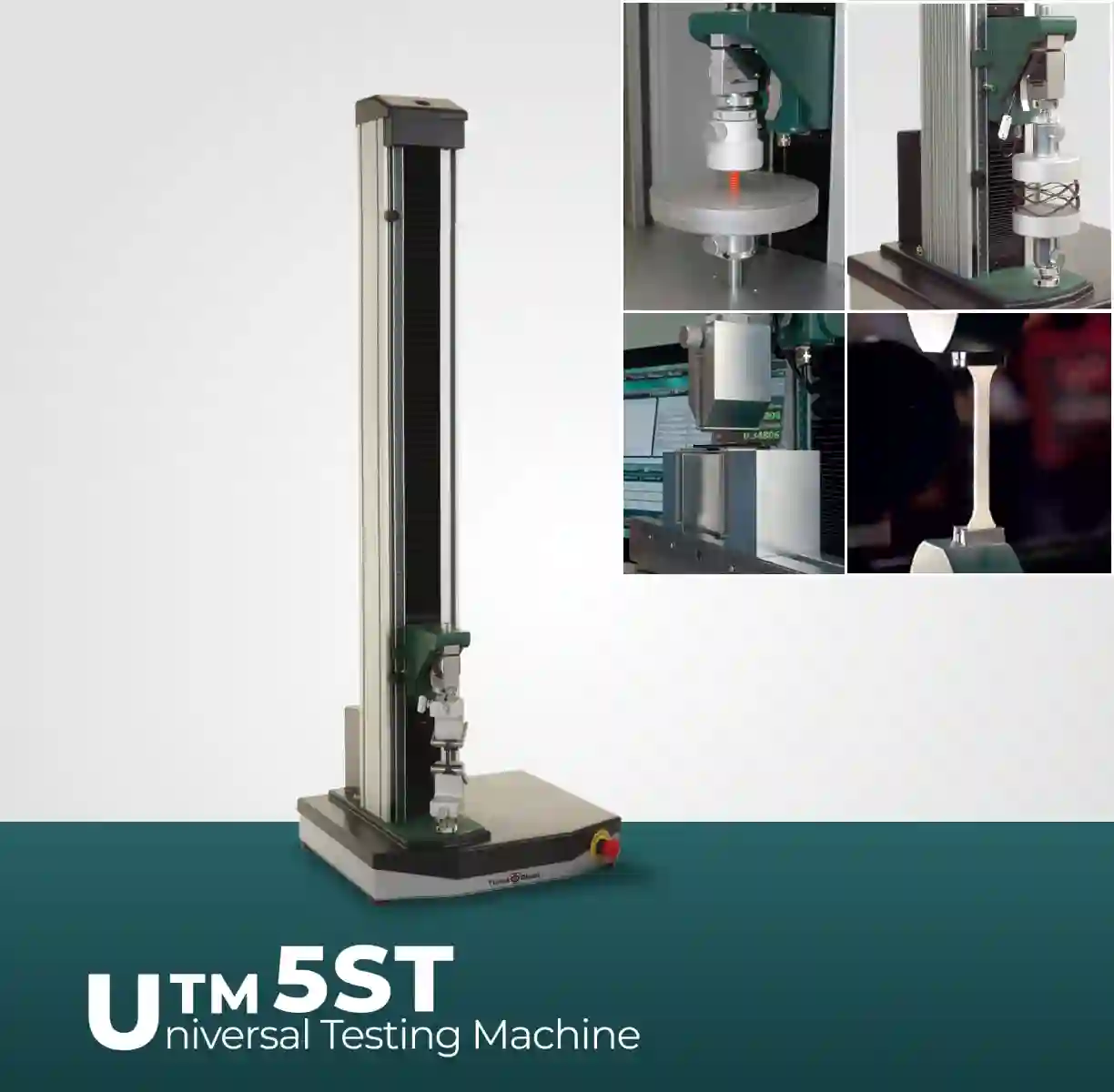
Tinius Olsen 5ST
5kN frame capacity
A compact 5 kN frame to evaluate for dedicated woven-sack fabric and seam testing, with load cells and grips matched to actual specimen forces.
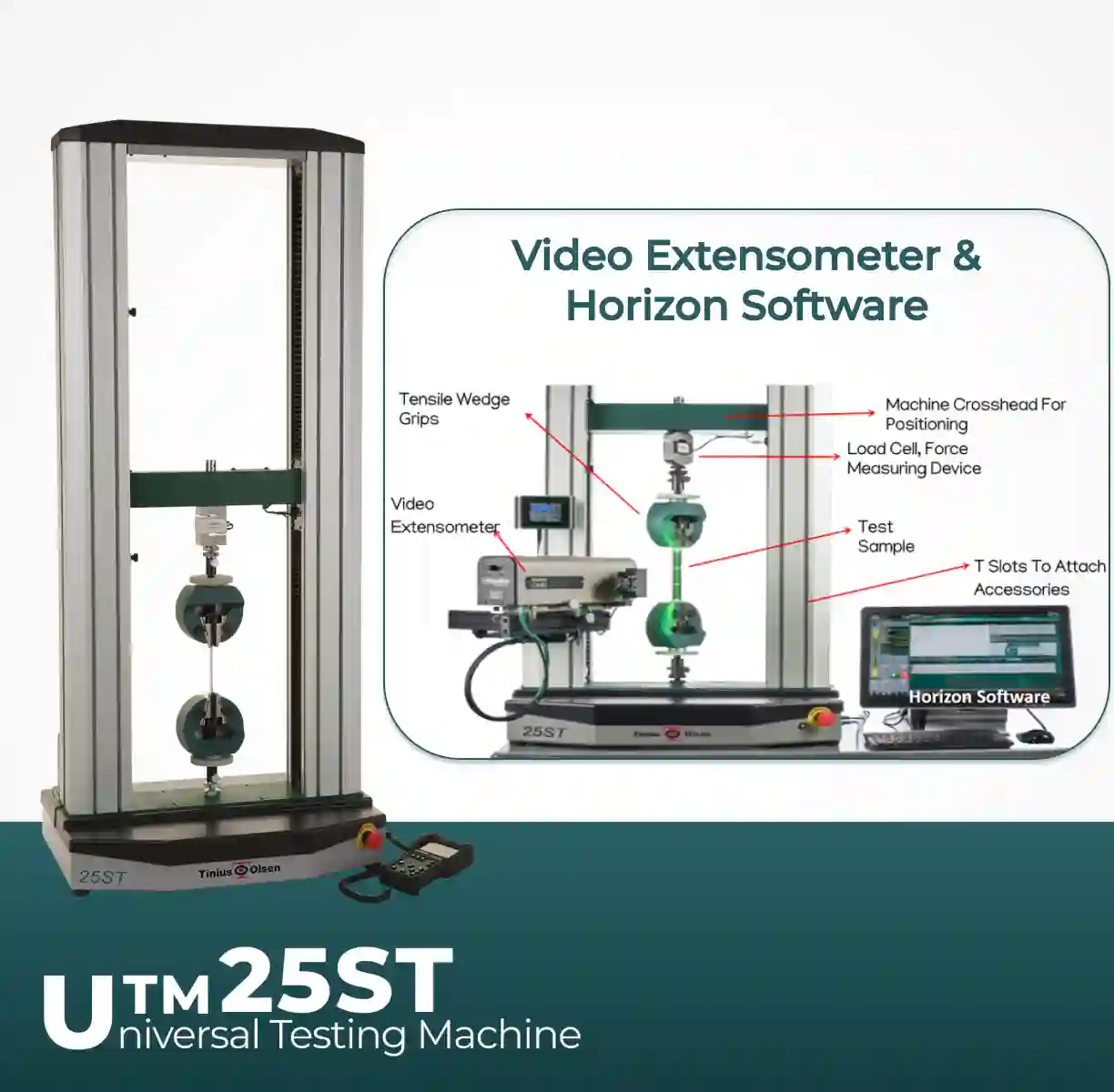
For dedicated woven-fabric and seam testing, evaluate the 5ST against actual specimen forces and fixture requirements. For higher-force specimens or a broader laboratory programme, evaluate the 25ST. Where applications span different force ranges, review the load-cell options.
Neither a 5 kN nor a 25 kN frame is automatically mandated by a woven-sack standard. The configuration follows the application.
Tensile testing within your quality programme
A UTM evaluates prepared specimens and is one part of the laboratory's quality programme. Map the applicable sack requirements to their methods, sample preparation and testing arrangements; purchasing a machine alone does not establish finished-sack compliance.
Discuss your woven-sack testing application with Flexitest
Whether you are establishing a laboratory or reviewing an existing tensile tester, start with your sack type, applicable standard and any available test results. These give Flexitest a basis for discussing the frame, load cell, grips and method setup.
If available, specimen dimensions, daily testing volume and existing test settings help refine the configuration. A representative sample trial can help resolve uncertain gripping or force requirements.