
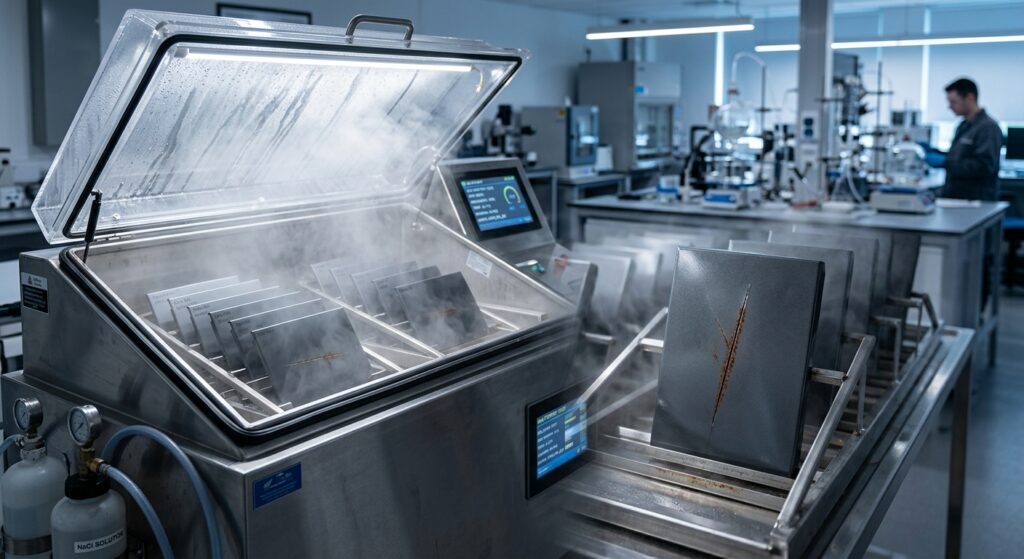
A salt spray chamber creates a controlled, highly corrosive salt fog, so coatings and materials that would take years to fail outdoors show their weaknesses in hours or weeks.
This guide explains what a salt spray test is, how a salt spray chamber works, which standards apply, which industries use it and what to look for when you buy one.
Why corrosion testing matters
A rusted bolt, a blistered paint finish or a peeling chrome trim costs far more than the part itself. It leads to warranty claims, rejected batches and lost customers. In a country like India, with a long coastline, high humidity and heavy monsoons, corrosion resistance is a basic quality requirement, not an extra.
Waiting years for outdoor exposure results is not practical for a production line. A salt spray chamber solves this by creating a controlled, highly corrosive salt fog that speeds up corrosion. Coatings and materials that would take years to fail outdoors show weaknesses in hours or weeks inside the chamber.
What is a salt spray test and how does the chamber work?
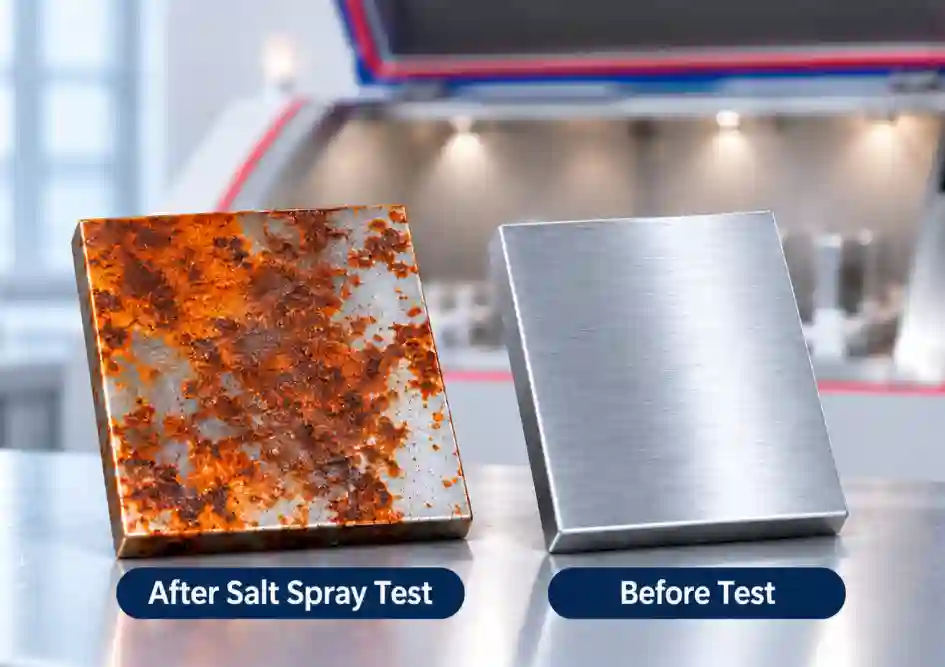
A salt spray test (also called a salt fog test) is an accelerated corrosion test. Coated or plated samples are placed in a closed chamber and exposed to a continuous fine mist of salt solution at a controlled temperature. After a set number of hours, the samples are checked for rust, blistering, creep from a scribe line and loss of adhesion.
In a typical neutral salt spray (NSS) test to ASTM B117, the chamber runs at 35 °C with a 5% sodium chloride solution at a pH of 6.5 to 7.2. The fog must settle on the samples at 1.0 to 2.0 ml per 80 cm² per hour, measured with collectors placed inside the chamber.
A salt spray chamber runs the test in five steps:
- Solution supply: Salt solution is prepared and stored in a reservoir tank.
- Air conditioning: Compressed air passes through a heated, water-filled saturator tower (humidifying tower), so it is warm and fully humid before it reaches the nozzle.
- Atomisation: The nozzle mixes the air and solution into a fine fog that fills the chamber.
- Exposure: Samples sit on racks at a fixed angle, usually 15° to 30° from the vertical, so the fog settles evenly on the test surface.
- Evaluation: After the set hours, samples are removed, rinsed and rated for corrosion against the customer's or standard's acceptance criteria.
Variants of the test change the solution or temperature. The acetic acid salt spray (AASS) test lowers the pH with acetic acid. The copper-accelerated acetic acid salt spray (CASS) test adds copper chloride and runs at 50 °C, which makes it much more aggressive and suitable for decorative nickel-chrome plating.
Salt spray test standards
ASTM B117 and ISO 9227 are the two standards most often written into customer specifications. The table lists the main standards a modern salt spray chamber should support.
| Standard | What it covers | Typical users |
|---|---|---|
| ASTM B117 | Operating salt spray (fog) apparatus; the base NSS method | All industries |
| ISO 9227 | Salt spray tests in artificial atmospheres: NSS, AASS and CASS | All industries, export suppliers |
| ISO 7253 | Neutral salt spray resistance of paints and varnishes | Paint and coating manufacturers |
| ASTM B368 | Copper-accelerated acetic acid salt spray (CASS) | Decorative chrome and nickel plating |
| ASTM B380 | Corrodkote procedure for decorative electroplated coatings | Electroplaters, automotive trims |
| ASTM G85 | Modified salt spray, including cyclic and acidified tests | Automotive and aerospace |
| ASTM D1735 | Water resistance of coatings using a water fog | Coating and plastics labs |
| ISO 4611 | Effects of damp heat, water spray and salt mist on plastics | Plastic and polymer processors |
| DIN 50021 | German salt spray test method (now largely replaced by ISO 9227) | Suppliers to German OEMs |
The customer specification normally names the standard, the test type and the number of hours. Check it before you set up a test, because a chamber that only meets ASTM B117 cannot run a CASS or water fog test.
Industries that use salt spray chambers
Paint and coating
Paint makers, powder coaters and electroplaters use salt spray testing to compare formulations, approve new suppliers and prove coating life to customers. Testers scribe a line through the paint film and measure how far corrosion creeps underneath it. Primers are often tested for 96 to 240 hours, while industrial paint systems can run 500 to 1,000 hours or more. Read more: salt spray chamber for paint and coating, or see our paint, coating and metals testing range.
Automotive
Vehicles face road salt, coastal air and monsoon splash, so OEMs ask for salt spray reports on fasteners, brake parts, chassis components, body panels and chrome trims. Plain zinc-plated fasteners may be specified at 72 to 96 hours, while zinc-nickel and zinc-flake coatings often need 720 hours or more. CASS testing is common for decorative plating, and cyclic tests based on ASTM G85 are growing. Read more: salt spray chamber for automotive parts, or see our automotive component testing range.
Plastic and polymer
Plastics do not rust, but chrome-plated plastic trims blister, painted housings lose adhesion and metal inserts corrode inside moulded parts. ISO 4611 sets out how to expose plastics to damp heat, water spray and salt mist, and ASTM D1735 covers water fog testing of coatings. Read more: salt spray chamber for plastics and polymers, or see our plastic and polymer testing range.
Other users include electrical and electronics makers (enclosures, connectors), fastener manufacturers, hardware and sanitaryware brands, solar mounting structure suppliers and marine equipment makers.

How to choose the right salt spray chamber
The right chamber depends on the standards you test to, the size of your parts and how long your tests run. Check these points before you buy:
- Standards supported: Make sure it can run every test your customers ask for: NSS, AASS, CASS and water fog, not just ASTM B117.
- Chamber material: Salt and acid fog attack metal parts and cheap plastics. Titanium or high-grade FRP interiors last longest.
- Temperature control: Look for PID control, uniformity of ±2 °C or better and enough range for CASS (50 °C working room, about 63 °C saturator).
- Spray system: Siphon nozzles can clog with salt crystals on long runs. A pump-fed system gives a steadier fog fall-out rate.
- Sample racks and load: Racks should hold panels at the correct angle and also take bulky or heavy parts.
- Programming and data: A programmable controller with data logging and export saves operator time and gives you records for audits.
- Size: Choose a working volume that fits your largest part and a typical batch, with space left for fog to circulate.
- Local service: Calibration, spares and quick support matter as much as the purchase price.
The Flexitest 880/T, 881/T and 882/T series
Flexitest's programmable salt spray chambers are built around these points:
- Chamber build: Titanium inner chamber with a painted steel outer body, silicone gasket seal and air-cylinder operated lid.
- Heating: PID air heating from the chamber walls, so the solution's concentration and pH are not affected. Working room RT+5 °C to 55 °C, saturator tower RT+5 °C to 65 °C, uniformity ≤ ±2 °C and stability ≤ ±0.5 °C.
- Spray system: Peristaltic pump spray system fed from a large external tank, with adjustable flow and no siphon-nozzle crystallisation.
- Sample rack: Three-level rack with corrosion-resistant rods, V-shaped glass-fibre brackets at 20° ± 5° and a mesh plate, rated above 200 kg.
- Controller: TEMI 880 7-inch touch-screen controller with program, fixed-value and timed start/stop modes. Continuous fog up to 999.9 hours; interval fog up to 99 h 59 min spray and 99 h 59 min pause.
- Data and networking: Data logging for up to 360 days at a 2-minute interval, USB program transfer and RS232 networking for up to 16 chambers.
- Safe design: Inclined cover that keeps condensate from dripping on samples, and fully separated water and electrical sections.
- Standards: ASTM B117, ASTM B368, ASTM B380, ASTM G85, ASTM D1735, ISO 9227, ISO 7253, ISO 4611 and DIN 50021.
Frequently asked questions
How many hours of salt spray testing equal one year outdoors?
There is no fixed conversion. Real-world corrosion depends on climate, pollution and how the part is used, so salt spray hours are best used to compare coatings and check them against a specification, not to predict exact service life.
What is the difference between NSS, AASS and CASS tests?
NSS uses a neutral 5% salt solution at 35 °C. AASS adds acetic acid to lower the pH. CASS adds acetic acid and copper chloride and runs at 50 °C, making it the most aggressive of the three.
What salt solution is used in a salt spray test?
ASTM B117 and ISO 9227 use a 5% sodium chloride solution made with high-purity salt and distilled or deionised water, with the pH adjusted to the range the standard sets.
How often should a salt spray chamber be calibrated?
Most labs calibrate temperature sensors and check fog collection at least once a year, and verify collection rates during every test as the standards require. Your quality system or accreditation body may ask for more frequent checks.
Can one chamber run both salt spray and water fog tests?
Yes, if the chamber supports it. The Flexitest 880/T series runs salt spray, CASS and ASTM D1735 water fog tests in the same cabinet.
Get a quote for your salt spray chamber
Flexitest supplies programmable salt spray chambers to paint, automotive, plastics and manufacturing companies across India. Tell us your standards, sample sizes and test hours, and our team will recommend the right model.
Get a quote or a demo today
Tell us your standards, sample sizes and test hours, and our team will recommend the right model.
Or call +91 93263 25135 · sales@flexitest.in
Flexitest, SF-A-13, 2nd Floor, Art Guild House, Phoenix Market City, LBS Road, Kurla (W), Mumbai 400070
