
From 6 October 2026, HDPE and PP woven sacks for 50 kg cement must carry the BIS Standard Mark under IS 11652:2017. The standard includes a UV resistance requirement that many sack plants have never had to prove on paper. This article explains what the clause asks for, how the test is run, and what equipment you need to run it.
What changed on 6 October 2026
The Quality Control Order for HDPE/PP woven cement sacks came into force on 6 October 2026. The Department of Chemicals and Petrochemicals fixed that date in an amendment order notified on 5 January 2026, after several earlier extensions.
In practice this means three things for a sack manufacturer:
- Every HDPE/PP woven sack for 50 kg cement that is manufactured, imported or sold in India must conform to IS 11652:2017 and carry the BIS Standard Mark.
- To use the mark you need a BIS licence, which means your product must pass every applicable test in the standard.
- Two related orders took effect on the same day: IS 16709:2017 for PP laminated block bottom valve cement sacks, and IS 17399:2020 for laminated mail sacks.
If you supply cement companies and do not yet hold a licence, testing is the first thing to put in place.
What IS 11652 says about UV resistance
UV-stabilised sack fabric must keep at least 50 percent of its original breaking strength after UV exposure. That is the requirement of clause 5.6, with the test method in Annex F, as BIS-recognised laboratories list it.
Polypropylene and HDPE tapes break down in sunlight. A sack that passes a strength test on the day it is stitched can turn brittle after weeks in an open yard, a rail siding or a dealer's godown. When it tears, cement is lost and the cement brand takes the complaint. The UV clause exists to catch that before the sack leaves your plant.
Three related points in the standard are worth knowing:
- Ash content. The limit is 2.2 percent for UV-stabilised sacks and 6 percent for non-UV-stabilised sacks.
- Stitching. For UV-stabilised sacks, the stitching tape or thread must be UV-stabilised too.
- Scope of the UV test. The clause applies to UV-stabilised sacks. BIS's testing scheme sets the test frequency "as agreed to between buyer and the seller".
So if your customer orders UV-stabilised sacks, 50 percent retention is the number you are certified against, and you need test reports to prove it.
How the UV weathering test is run
The test compares the fabric's breaking strength before and after a fixed period in an accelerated weathering chamber.
- Measure the original strength. Cut fabric specimens and test breaking strength lengthwise and widthwise on a tensile tester, using the ravelled strip method of IS 1969 (Part 1).
- Expose a second set of specimens. Place them in a UV weathering chamber. BIS-recognised labs list the exposure for IS 11652 as 192 hours — eight days of continuous running.
- Cycle UV and moisture. For this family of woven sack standards, labs describe the cycle as 8 hours of UV light at 60°C followed by 4 hours of dark condensation at 50°C. The UV step imitates sunlight and the condensation step imitates night-time dew.
- Test again and calculate retention. Break the exposed specimens on the same tensile tester. Retention is the strength after exposure divided by the original strength, times 100.
Outside lab or your own chamber?
An outside lab works for an occasional test, but it is slow and costly once you test regularly. The exposure alone takes eight days, before courier time and the lab's queue.
Your own chamber pays back when any of these apply:
- You change the UV masterbatch dose, resin grade, tape denier or supplier, and need to know the effect before a full production run.
- You supply more than one cement company, each with its own sack specification.
- Your buyers ask for a UV retention report with each lot.
- You want to find a weak batch yourself, before a BIS sample or a customer complaint finds it.
Which accelerated weathering chamber fits a sack plant
For the IS 11652 UV test, a fluorescent UV chamber with a condensation cycle is the right instrument. Flexitest supplies the ST UVA/UVB floor-standing chamber, plus a benchtop version and a xenon arc chamber for plants that also test print and colour.
| Model | Light source | Samples per run | Irradiance | Best for |
|---|---|---|---|---|
| UV Chamber ST UVA/UVB | 8 × 40 W fluorescent lamps, UVA-340 or UVB-313 | 48 specimens (150 × 70 mm) | 0.3 – 1.55 W/m², settable | Plants running several fabric grades or customers. BPT control up to 80°C and condensation system. |
Most cement sack plants should start with the ST chamber. It holds 48 specimens, so lengthwise and widthwise sets from several lots can run in the same eight days.
The chamber is half of the test. You also need a universal testing machine to measure breaking strength before and after exposure.
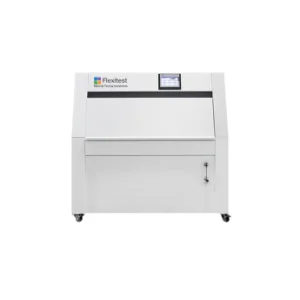
Related machine
UV Chamber ST UVA/UVB
Floor-standing UV weathering chamber for accelerated ageing of packaging films, labels and woven sacks using UVA and UVB fluorescent lamps.
View details →Set up your UV test before the next audit
IS 11652 is now law for 50 kg cement sacks, and UV retention is one of the results your customers and BIS can ask you to prove. Flexitest supplies the weathering chamber and the tensile tester, with free installation and operator training, and branches in Mumbai, Delhi, Ahmedabad, Vadodara, Pune, Hyderabad and Chennai.
Send us your sack specification and your customer's UV requirement, and we will recommend the chamber and lamp type to match.
Get a quote or a demo today
Tell us your sack specification, UV masterbatch dose, and test frequency requirement — we'll recommend the right chamber.
Email: sales@flexitest.in
Phone: +91 22-4970 6073 · +91 93263 25135
Sources
- Gazette notification of 5 January 2026: amendment orders for three types of woven sacks (Department of Chemicals and Petrochemicals)
- BIS note on IS 11652:2017 and the Quality Control Order
- BIS Scheme of Testing and Inspection for IS 11652:2017, January 2018
- BIS LIMS lab scope: IS 11652 clause 5.6 and ash content limits
- BIS LIMS lab scope: test charges for IS 11652 UV exposure
- BIS LIMS listing: 192-hour UV conditioning for IS 11652
- BIS LIMS lab scope: 8 h at 60°C and 4 h at 50°C cycle for woven sack standards
- Corpseed summary of the January 2026 amendment orders
- Flexitest product pages: ST UVA/UVB, SB UVA/UVB benchtop, SX/1000 xenon
