
Fresh-seal performance on form-fill lines
Hot tack answers a time-critical question
Will a newly made seal stay closed while it is still hot? Hot tack is the strength of a heat seal immediately after sealing, before it cools. On a form-fill line, a pouch may be filled, dropped or transferred while that strength is still developing.
A laminate can pass a cooled seal-strength test and still open on the line because the two tests examine different moments. Hot-tack testing helps compare materials and identify a practical sealing window; final settings must still be confirmed on the production machine.
Make the right test decision
Hot tack vs cooled seal strength
Measured after a controlled delay following the sealing cycle.
Buyer question: Can the fresh seal resist product impact or early handling?
Relevant method: ASTM F1921/F1921M.
Measured after the specimen reaches the method's defined cooled condition.
Buyer question: How strong is the finished seal for handling and distribution?
Relevant method: ASTM F88/F88M. Force is measured on suitable seal-strength equipment.
Diagnose the failure timing
Why freshly made seals fail during filling
Product impact
On VFFS lines, falling product can load the bottom seal before it has fully cooled.
Early transfer
Pulling, gripping or conveyor transfer can stress a new seal seconds after formation.
Narrow process window
A setting that works only at one point may not tolerate normal variation in film or equipment.
By the same principle, hot tack is relevant to HFFS and other form-fill operations whenever downstream handling loads the seal before it cools.
Build evidence, not a single lucky setting
Four variables define the sealing window
Temperature
Test a useful range; more heat does not automatically mean better hot tack.
Dwell time
Compare the contact times your production cycle can realistically deliver.
Pressure
Keep applied pressure controlled while other factors are varied.
Delay
Match the time between sealing and loading as closely as the method allows.
Plot force across the planned combinations, then look for a stable operating region above the application's acceptance threshold—not simply the highest individual reading. Laboratory curves are a starting point because production seal area, speed and heat transfer can differ.
What the published application example shows
Compare the shape of the window, not someone else's settings
Labthink's historical Film A/Film B example varied sealing temperature and dwell time under controlled conditions to compare two candidate films. The useful lesson is the method: evaluate each film across a matrix and select a window that provides adequate fresh-seal force with operating margin.
The example's temperatures, times and force target belong to that cited application. They are not universal settings for another laminate, pouch format or filling line.
Choose the test your lab needs
C632M for the fresh seal; C630H for controlled seal preparation
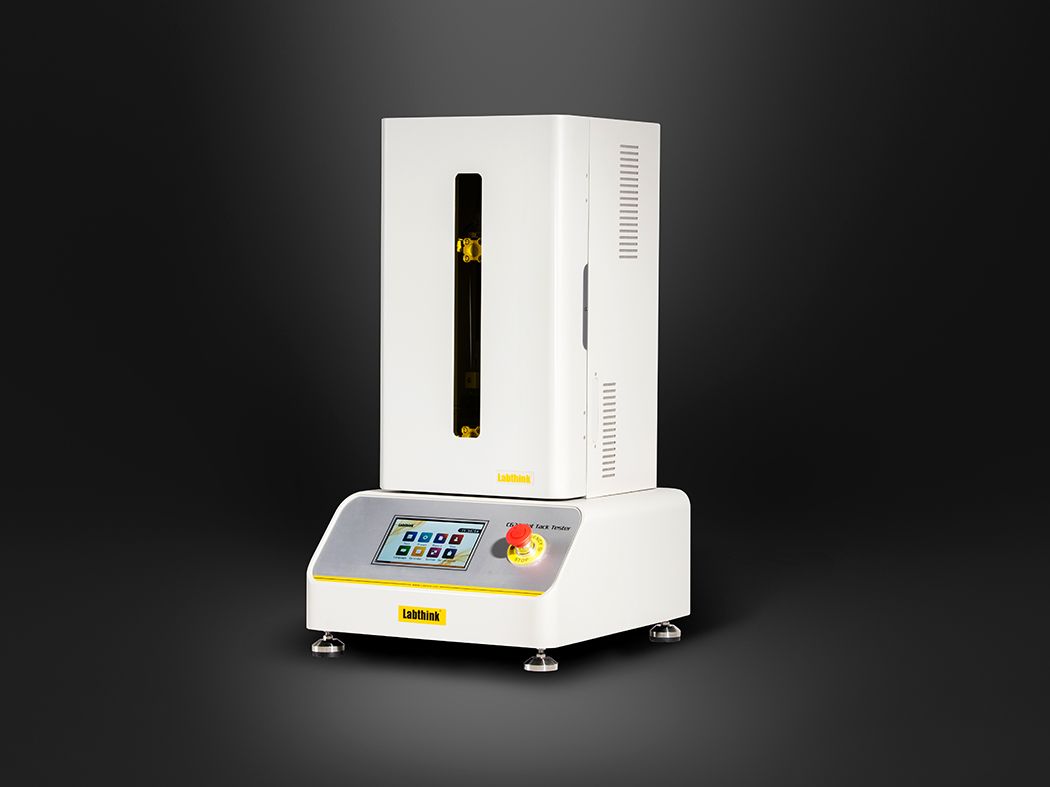
C632M Hot Tack Tester
Forms the seal and measures hot-tack force after a controlled delay, before cooling.
Use when: seals open during filling, dropping or immediate transfer.
Labthink lists ASTM F1921
C630H Heat Seal Tester
Prepares controlled laboratory seals while varying temperature, pressure and dwell time.
Use when: developing a sealing window or preparing specimens for separate cooled-strength testing.
Labthink lists ASTM F2029Questions packaging teams ask
Practical hot-tack testing questions
Why can a seal pass after cooling but fail during filling?
The fresh seal is being loaded before it develops its cooled strength. Measure hot tack at a controlled delay that reflects the failure timing, then confirm the chosen settings on the production line.
Does a higher sealing temperature always improve hot tack?
No. A film can have an optimum region, and hot-tack force may level off or fall outside it. Test a temperature, pressure and dwell-time matrix for the actual laminate.
Which machine should I choose: C632M or C630H?
Choose C632M when the required result is fresh-seal force after a controlled delay. Choose C630H when the objective is controlled seal preparation or sealing-window development; cooled seal strength is measured separately.
What information helps with a test recommendation?
Share the laminate structure, line type and speed, pack size and fill weight, current sealing conditions, and exactly when and where the seal opens.