
Dynamic Climate Chamber vs. Drying and Heating Chamber: How to Choose the Right One
Walk into almost any materials testing, quality assurance, or R&D lab, and you'll find some version of a temperature-controlled chamber humming in the corner.
But "temperature chamber" is a broad category, and two of the most commonly confused types are the dynamic climate chamber (DCC) and the drying and heating chamber (DHC). They can look similar from the outside - insulated steel boxes with a control panel - but they're built to do very different jobs.
Choosing the wrong one is an expensive mistake: you either pay for climate-simulation capability you'll never use, or you under-equip your lab for the compliance and durability tests your standards actually require.
What is a Dynamic Climate Chamber (DCC)?
A dynamic climate chamber is purpose-built for cyclical and complex climate testing. It's designed to move quickly and repeatedly between temperature and humidity extremes, replicating what a product might experience across seasons, altitude changes, or transport conditions - in a fraction of the real-world time.
- Wide temperature range: commonly -40°C to 180°C, with specialized models reaching down to -70°C for cold-climate testing
- Humidity control: many models regulate relative humidity across roughly 10% to 98% RH using precision sensors and vapour humidification
- Fast, repeatable cycling: rapid alternation speeds (often around 5 K/min) enable standards-compliant cyclical testing
- Programmability: onboard controllers typically store dozens of programs with up to 100 process steps each for unattended multi-day profiles
- Standards compliance: designed to meet current IEC, EN, and MIL testing standards
A DCC earns its keep in stress testing, stability testing, and durability testing across automotive components, electronics, aerospace parts, coatings, and materials science - anywhere you need to know how something holds up when climate conditions swing.
What is a Drying and Heating Chamber (DHC)?
A drying and heating chamber is the workhorse for routine thermal processing: drying, heating, curing, sterilizing, and material aging. There's no humidity simulation and no rapid climate cycling - the goal is stable, uniform, energy-efficient heat.
- Broad, steady temperature range: typically 5°C to 300°C - well above what climate chambers offer, since drying and sterilization tasks call for sustained high heat
- Natural or forced convection: natural-convection models suit gentle gradual drying; forced-convection models use fans for fast homogeneous heat distribution
- Temperature uniformity: quality units maintain tight accuracy and recover quickly after door openings for repeat-batch work
- Efficiency-focused design: strong thermal insulation and optimized heating elements keep energy costs low during long continuous cycles
- Application versatility: used across industry, science, and QA including processes governed by EN 1539:2015
A DHC earns its keep in routine lab drying, sterilization, curing, tempering, and any process where you need dependable, uniform heat rather than simulated environmental stress.
At a glance - key differences
🌡 Dynamic Climate Chamber
- Simulates variable climate conditions
- Temperature: -70°C to 180°C
- Humidity: 10% – 98% RH
- Rapid programmable cycling (~5 K/min)
- Stress, stability & durability testing
- Meets IEC, EN, MIL standards
🔥 Drying & Heating Chamber
- Applies stable, controlled heat
- Temperature: 5°C to 300°C
- No humidity control
- Steady-state heating only
- Drying, curing, sterilization, aging
- Meets EN 1539:2015 & related standards
Side-by-side comparison
| Feature | Dynamic Climate Chamber | Drying & Heating Chamber |
|---|---|---|
| Primary function | Simulate variable climate conditions | Apply stable, controlled heat |
| Temperature range | -70°C to 180°C (model-dependent) | 5°C to 300°C |
| Humidity control | ✓ Yes - 10–98% RH | ✗ No |
| Cycling speed | Rapid (~5 K/min), programmable | Steady-state heating only |
| Typical use cases | Stress, stability, cyclical durability tests | Drying, sterilization, curing, aging, tempering |
| Standards met | IEC, EN, MIL for DCC | EN 1539:2015 and related standards |
| Best for | Simulating real-world variation | Efficient thermal processing |
How to choose between a DCC and a DHC
Ask yourself one question: does your test need to change conditions, or just apply heat?
Choose based on your testing need
💡 Many labs run both side by side: a DHC for daily sample prep and processing, and a DCC for the more demanding qualification and stability testing that standards or customers require.
Beyond the DCC-vs-DHC decision, the right unit also depends on chamber volume, required ramp rates, load size, refrigerant type, controller and data-logging needs, and industry-specific standards - details that are hard to generalize in a blog post.
Not sure which chamber or oven fits your application?
Chamber selection gets specific fast – temperature range, humidity needs, chamber volume, ramp rates, load size, and the standards you’re testing against all shape the right recommendation. Tell us about your particular requirement below and we’ll match it to the right chamber or oven.
Takes about 2 minutes. The more detail you give us, the more precise the recommendation.
OR
Not sure which chamber fits your application?
Chamber selection gets specific fast. Tell us about your requirement and we’ll help you match it to the right chamber or oven.
- What you're testing and your industry
- Required temperature range and humidity needs
- Chamber size or typical load volume
- Standards you need to comply with (IEC, EN, MIL, ISTA etc.)
- Whether the unit will be for routine processing or qualification testing
or email sales@flexitest.in · www.flexitest.in
Recent Post
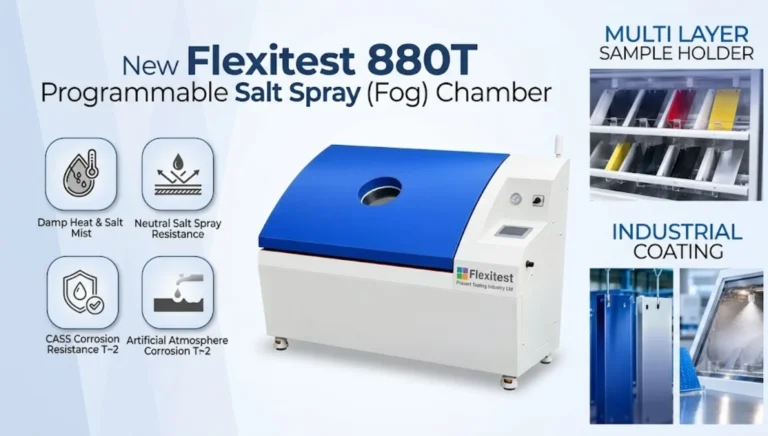
Salt Spray Chamber: A Complete Guide to Salt Spray Corrosion Testing
How a salt spray chamber works, the ASTM B117 and ISO 9227 standards, which industries use it and how to...
Read More
HDPE & PP Woven Sack Testing: BIS Requirements and Choosing the Right UTM
Review BIS woven-sack requirements, fabric and seam testing, and verified Tinius Olsen 5ST and 25ST specifications for your HDPE or...
Read More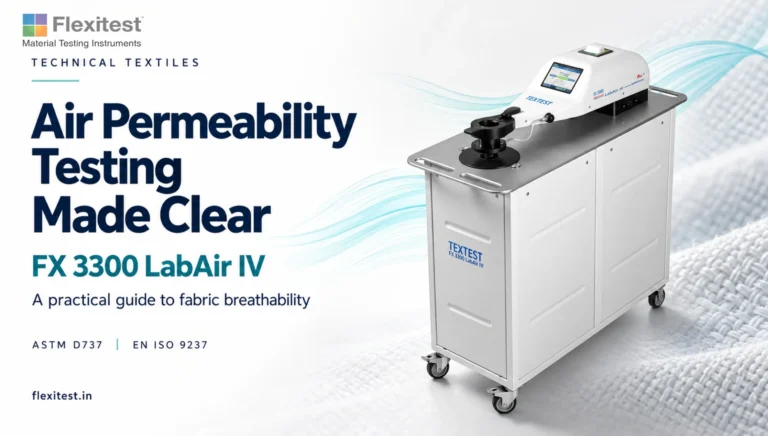
Air Permeability Tester for Technical Textiles: A Complete Guide to the FX 3300 LabAir IV
What air permeability is, why it matters for airbags, filters and technical textiles, how it is tested, and a close...
Read More
Coefficient of Friction Tester: What It is, Why It Matters, and How to Choose the Right One
Learn how coefficient of friction testing supports packaging performance, compare C620H and MXD-02 testers, and choose a configuration for your...
Read More