What an automotive fogging test measures
Published 7 May 2025 | Updated 17 August 2026 | Flexitest
In brief: An automotive fogging test heats a representative interior material under controlled conditions and collects condensable emissions on a cooled surface. The laboratory then evaluates the deposit by its effect on gloss or reflectance, by added mass, or by optical haze, according to the applicable standard or OEM specification.
Instrument panels, synthetic leather, foams, adhesives, textiles, sealants and other cabin materials can release condensable constituents when warmed. If a deposit forms on glazing, it can affect light transmission or visibility. Fogging testing gives OEMs, Tier 1 suppliers and material laboratories a repeatable way to compare that tendency before a material is approved for vehicle interiors.
A fogging result is a method-specific material-performance result. It does not identify individual volatile compounds and should not be interpreted as a direct measurement of cabin toxicity. Chemical identification or total VOC work requires a different analytical method.
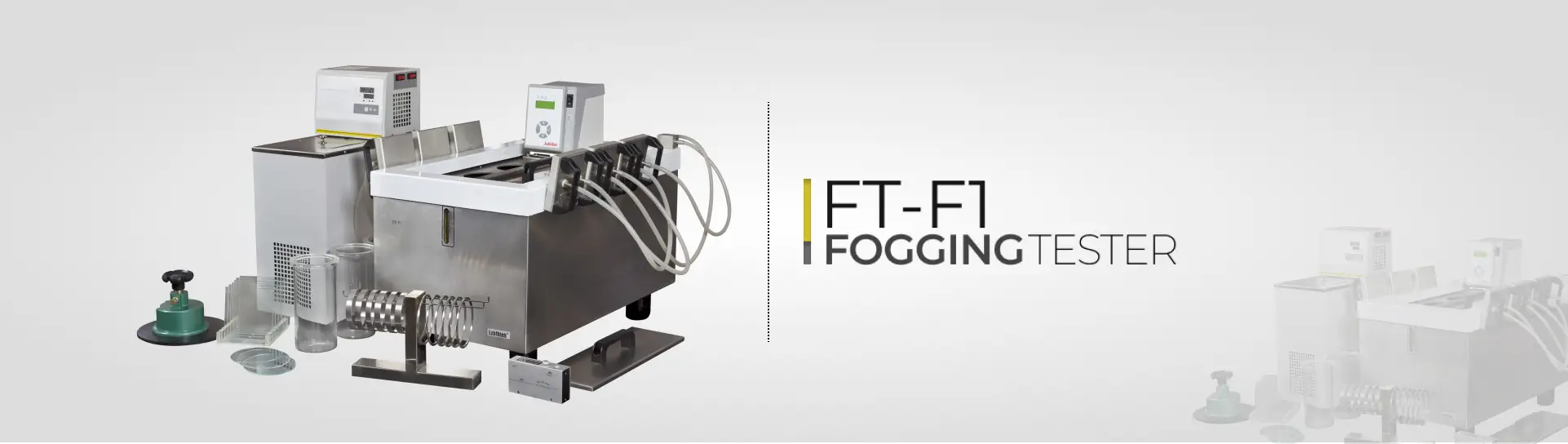
The three commonly encountered outputs are reflectometric or gloss change, gravimetric mass gain and haze change. The FT-F1 Automotive Fogging Tester is designed to support these laboratory workflows; the sections below explain what each result means before a laboratory selects a method.
How a fogging test works
A prepared specimen is placed in a controlled heating station and covered by a collector assembly. While the specimen is heated, condensable emissions move toward a cooler glass plate or aluminium foil above it. The collector is then conditioned and measured using the procedure specified by the governing method.
- Prepare the specimen: use the required dimensions, exposed surface and conditioning procedure.
- Control heating and cooling: keep the specimen station and collector at the temperatures defined by the controlled method.
- Collect the deposit: use clean glass for an optical result or clean aluminium foil for a mass result.
- Condition and measure: apply the specified waiting period, atmosphere and measuring instrument.
- Validate the run: use blanks, reference materials or verification checks required by the method.
The numerical outputs from different methods are not interchangeable. A gloss ratio, a mass gain and a haze change describe different properties of the deposited film, even when the same material is tested.
Three automotive fogging test methods
1. Reflectometric or gloss method
This method collects the deposit on glass and compares its optical reflectance or gloss before and after exposure. The reported value expresses how much of the original reflective response remains after fogging. It is useful when the concern is the effect of a film on a windscreen-like surface.
Clean glass, consistent measurement geometry and controlled conditioning are essential. A transparent or uneven oily film can affect an optical reading differently from a uniform light-scattering deposit.
2. Gravimetric method
The gravimetric method uses pre-weighed aluminium foil as the collector. After exposure and conditioning, the foil is weighed again and the increase in mass represents the collected condensate under the specified test conditions.
This method directly measures deposit mass rather than optical appearance. The public abstract for ISO 6452:2021 notes that a gravimetric method is preferred when condensate coalesces into a thin transparent or heavy oily film that can make an optical reading misleading.
3. Haze method
The haze method collects the deposit on glass and measures the change in light scattering with a haze meter. It is relevant where an OEM or customer specification evaluates loss of optical clarity rather than retained gloss or total deposited mass.
Haze and gloss both use glass collectors, but they are different measurands. Laboratories should use the optical instrument, geometry, conditioning and calculation stated in the applicable method.
Standards and method selection
The customer drawing, material specification or purchase order should determine the method and edition used for acceptance testing. As of this update:
- ISO 6452:2021 covers the fogging characteristics of automotive interior trim materials and describes measurement of condensate on glass, with gravimetric evaluation preferred in conditions where an optical film can give a misleading result.
- DIN 75201:2024-06 is the current DIN publication for determining fogging characteristics of automotive interior trim materials and applicable raw materials.
- SAE J1756_202604 publicly describes two evaluations: a light-scattering deposit on glass and a measurable deposit on aluminium foil.
Haze requirements may also come from an OEM or customer-specific method. Do not assume that every named standard contains every output. Confirm the exact edition, specimen preparation, exposure conditions, collector, conditioning procedure, calculation and acceptance limit from the controlled document used by your customer.
This article is a method-selection guide and is not a substitute for an authorised copy of a standard.
Gloss vs gravimetric vs haze: quick comparison
| Method | What is measured | Collector | Use it when |
|---|---|---|---|
| Reflectometric / gloss | Change in reflected light or retained gloss | Glass plate | The specified acceptance criterion concerns an optical deposit on glass |
| Gravimetric | Increase in collected deposit mass | Aluminium foil | The method requires condensate mass or an optical film may be misleading |
| Haze | Change in light scattering | Glass plate | An OEM or customer method specifies haze or optical clarity |
How to choose the right result
Start with the method mandated by the customer. If the requirement allows a choice, document the decision against these five points:
- Acceptance requirement: retained gloss, haze change or condensate mass.
- Material behaviour: whether the deposit is uniform, transparent, oily or strongly light-scattering.
- Laboratory capability: suitable gloss, haze or analytical weighing equipment and controlled conditioning.
- Comparability: the same standard edition, method and reporting basis used by the customer and supplier.
- Traceability: recorded specimen preparation, collector identification, exposure station and verification status.
For an Indian supplier serving several vehicle manufacturers, a simple method matrix can prevent avoidable retesting. Record the customer, part or material family, standard and edition, method, conditioning, result unit and acceptance limit. Keep results from different methods in separate data series.
Good laboratory practice for repeatable fogging results
Repeatability depends on the entire workflow, not only the heating bath. Use representative specimens, avoid contaminating the exposed surface, clean collectors consistently, stabilise the heating and cooling systems, and follow the prescribed conditioning interval before measurement.
Record the standard edition, method, specimen orientation, collector, station, exposure conditions, conditioning conditions, measuring instrument and final result. Blank or reference checks should be completed at the frequency required by the controlled procedure. A precise instrument cannot compensate for a dirty collector, mixed standard editions or uncontrolled sample handling.
Need to match an OEM or customer fogging requirement? Review the FT-F1 Automotive Fogging Tester for gloss, gravimetric and haze workflows, then share your standard and method list with Flexitest when requesting a quotation.
Need help selecting the right fogging test method?
Recent Post

Weathering Chamber Quotation Checklist for Automotive Labs